Thursday, May 19, 2011

Miracle Baby

Stacie pregnant in Paradise
On May 13 we celebrated the birthday of Georgie Eggers, the boy we call the “Miracle Baby,” a baby who died before he was even born and then -- here’s the miracle -- came back, learned to breathe and cry and eat and laugh and talk, all quite spectacularly, in the eleven months since he was released from the baby intensive care unit of the Miami hospital. 
    George’s time in his mother’s womb was happy. Stacie is a well-loved woman, and particularly beautiful when pregnant. A few months before the birth Stacie, and her long-time partner Rob, staged a quintessential island wedding at Higgs Beach followed by a reception at Salute. Stacie ordered her dress from  maternityweddingdresses.com. Family, friends and their four daughters, his, hers and theirs, stood in the warm sun on a cool and breezy winter day, while Stacie and Rob promised to each other to stick things out together, forever. Their oldest daughters wrote the marriage vows and prompted their parents to recite them to each other. Most of the wedding guests cried. It was so sweet. They were so happy. Stacie was so beautifully pregnant. Their daughters wore white dresses and matching high-top sneakers.
The wedding party
    Days later Stacie visited the doctor for an ultrasound and a peek at the baby in her belly. The doctor pointed out something that had not appeared on any of Stacie’s babies before.
    “See that?” the doctor said, pointing. “That’s a penis.”
    “Oh no, I don’t think so,” Stacie said, leaning over to brush the speck away with her finger. “That’s just dust or something on the screen.” 
    It wasn’t dust. It was big news. A boy! With four sisters, and a hundred more family and friends, joyfully anticipating his arrival. A boy, who would be called George, after his grandfather George, a superstar in his own right, who’d died just a month earlier.
    The labor started in the wee, dark hours after the other kids were asleep. At the hospital all went normally, although I hasten to add my nurse mother’s admonishment to me about birthing babies: no two births are ever alike. Nonetheless, Stacie knew the ropes, having been in the same position twice before with predictable results. She huffed and puffed and endured the labor. Rob was supportive. The nurses were great. There was joy. There was laughter. Everything was good. And then, suddenly and horribly, everything was bad. 
    Shoulder dystocia is when, after the birth of a baby's head, the baby's shoulder gets caught under the mother's pubic bone preventing delivery of the rest of the baby. It is rare, happening in only 0.5% of all births. It is every obstetrician’s worst nightmare. Generally it happens to women with gestational diabetes, or to particularly large women. None of that in Stacie’s case. It just happened, for no reason anyone can know. And when it did, George’s oxygen supply was cut off and . . . he died.        
    Stacie’s memories of that horrible few minutes are muddled. George was eventually unstuck, and immediately rushed away by a team of medics who battled to revive him. He was still. Perfectly formed. Beautiful even. But motionless. And breathless. No crying. No sound but the rustling of the medical personnel as they struggled to bring the baby back to life.
    As the critical care nurses who man the helicopter ambulance to Miami prepared George for the flight, Stacie asked “Please let me see his eyes.” So they did. They pulled his eyelids open and Stacie saw George’s blue eyes. Somehow, it calmed her. Then, the terrible phone calls. To family and friends. The new baby news was not good. George’s sisters were told when they came home from school. Throughout the day the word of George’s birth spread around the island. Stacie’s out-of-town family members began to arrive, one by one. The vigil was on. Each day we waited for news from Miami. Stacie pumped breast milk for George, froze it and took it to him every few days.
Georgie (6 months old) and Michael
    Baby Georgie was quickly tagged the “Miracle Baby” after surviving his first hours on earth. He breathed with the help of a respirator, that pushed the air in and out of his lungs. IVs delivered drugs into his blood to prevent him from having seizures. Tubes poured Stacie’s milk into his stomach. Then the respirator was turned off. He breathed. Then Stacie fed him. He sucked. Then, his brain waves waved back to the doctors. His brain was intact! George was making it, a breath at a time. What had been a grave prognosis grew more promising with each passing day. 
    One day Rob and Stacie were headed to Miami with a supply of frozen breast milk. Their two-year-old Lev was there, too, strapped into her seat and confused by the whirlwind of activity that had overtaken her family. In Marathon, at the end of the Seven Mile Bridge, where the speed limit is 35, they were stopped for speeding. The cop asked Rob where he was going “in such a hurry.”
    “The baby. . .” he stumbled. “The milk. We’re taking milk to our sick baby.”
    Then, to Stacie’s surprise, Rob began to sob. The dam of composure that had held him together since his son’s birth suddenly burst, his grief a flood. Then Stacie cried. And so did Lev.
Happy first birthday, Georgie. 5/13/2011
    “My son was there, too,” the cop finally said, choking back tears of his own. “Please drive carefully. Your son needs you now.”
     We were a bit wary of babysitting George when he first came home from the hospital. Through the years we’ve babysat all of Stacie and Rob’s girls, but this was different. Just before the family left us alone with the Miracle Baby for the first time his big sister Tessa, of the wry humor, cheerfully instructed that if George were to stop breathing we were to slap the bottoms of his feet. (Nothing like that has ever happened, thank goodness.)
    We love babysitting George. Seeing the little guy thrive, doing all the adorable things little guys do and doing them all well indeed, is better for us than any anti-depressant or meditation. He is affectionate. He giggles. He walks. He talks. I swear he says “Junie." Georgie is survival personified.
    This week George was given immunization shots. Five in all. He cried a bit, but quickly recovered. His sunny disposition surprised the nurse wielding the needle.
    “Wow,” the nurse said to Stacie. “He’s a tough little kid.”
    “Yes, he is,” Stacie agreed, adding, “he’s been to the other side.”

Sunday, May 15, 2011

Fort Elizabeth Taylor

Greetings from Ft. Elizabeth Taylor State Park
We’re at the beach. You will often find us here. It’s a great place to read, to rest, to avoid the real world. Sometimes we fix burgers at the beach because for my man there’s nothing like firing up the grill and cooking food on it in the great out-of-doors. All men seem to love this. You’d think they’d invented it. It’s silly, yes, but it’s bigger than all of us, so why fight it? 
    When special family or friends come to visit, we entertain with a picnic at the beach. I make my famous Martha Stewart Sandwich. Here’s how you do it. Buy a round loaf of whole grain or artisan bread and cut it in half as you would an English muffin. Dig out the bread until you have a cozy shell of bread and crust, bottom and top. You do this to make room for the stuff you’ll put into the sandwich. Layer stuff like fresh basil, lettuce, Italian salad dressing, salami, ham, smoked turkey, exotic cheese, mayo, tomato slices, mushrooms, or whatever other wonderful things you can pile into a Dagwood sandwich.  Use more salt and pepper than you think is enough. When it’s stuffed wrap it in Saran Wrap. Swaddle it tight, as you would a new baby. Then wrap that in aluminum foil. Put a heavy book, like the Big Book of AA or a Martha Stewart cookbook, on top to weight it down. Chill the whole thing, book and all, in the ‘fridge. After three hours or so, or overnight, the sandwich is ready.  A good Martha Stewart will feed eight people and set you back around $50. Take it to the beach, pull out a bread knife, cut the whole thing down the middle and slice off sandwiches.  You can make it vegetarian, too, easily. Everybody loves the the Martha Stewart Sandwich. Serve with chips and salsa and drinks.
Jennifer and June, John Jay High School classmates
    A few weeks ago we were here at the beach, Michael grilling hamburgers. My busy son Miguel made an appearance. Jennifer Ruger, a girl I went to John Jay High School with, entertained us with harrowing stories of her search for the perfect nest and job in her new home of Key West.
     “You got here too late,” I told her.
    “What time was I supposed to be here?” she asked. 
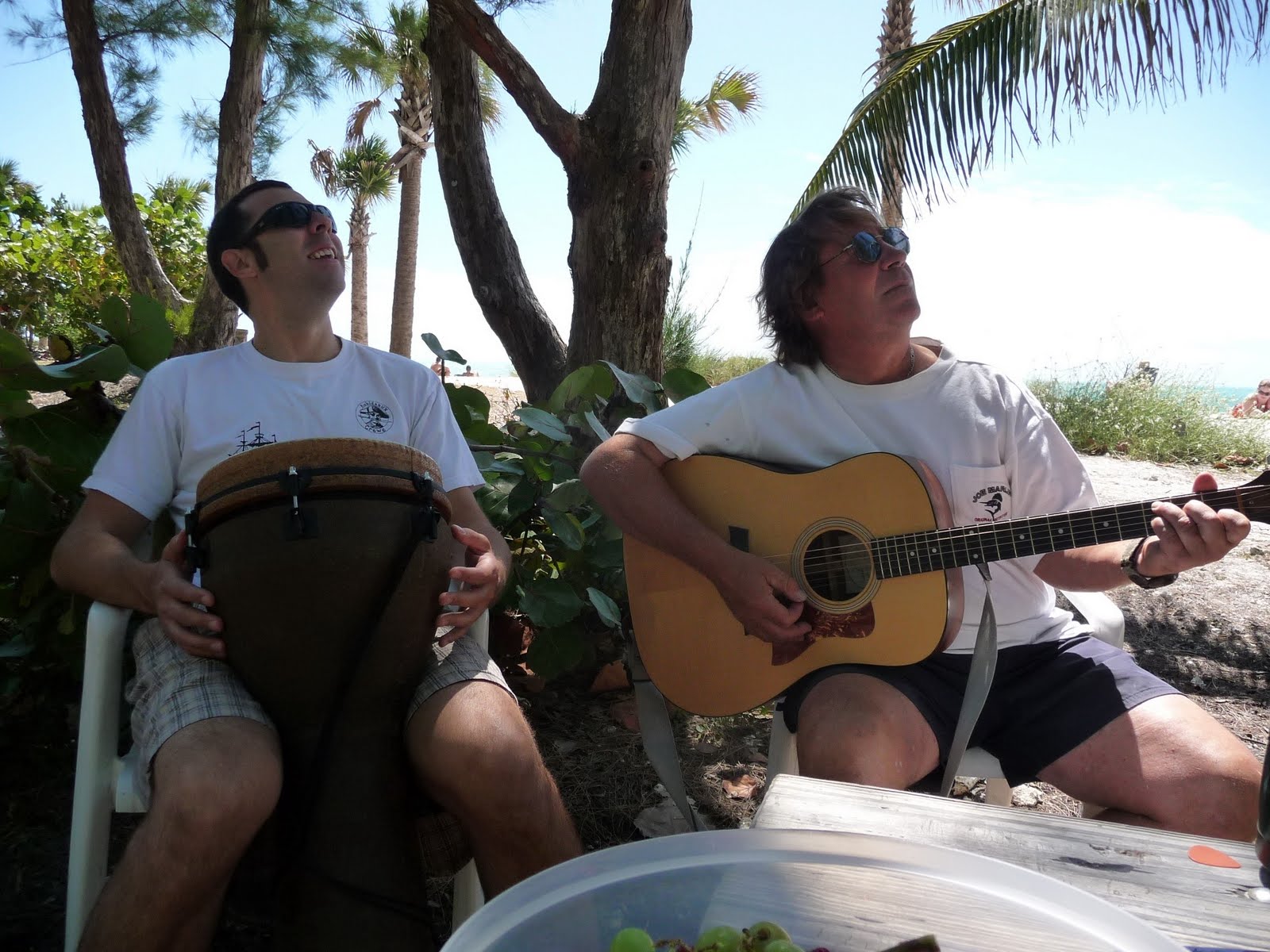
Miguel Perez and Peter Harrison jamming at the beach
    “About 20 years ago” I said. 
    She doesn’t care. She’s staying. She’s gonna squeeze that famous charm out of this old island no matter what it takes. Determination is one of her strongest traits. Jennifer’s landlady told her that you feel good at the beach because the salt air alters your body chemistry, something to do with charging ions, creating a sense of well-being. Leave it to a newcomer to explain to us why we are so happy here.
    It was a cloudless day. A little yellow airplane flew past the beach, trailing behind it a banner that said “Agate, will you marry me?” The plane made three passes and flew away, leaving us to wonder if Agate had noticed the plane, if she was indeed a woman, and if she was, how did we pronounce her name? Minutes later there was a small commotion a few hundred feet down the beach. It was Agate and her boyfriend!
    “What if she didn’t want to come to the beach today?” Miguel said. “What if she was sleeping when the plane came over?”
    Clearly, Miguel worries too much.
    Agate said yes. We cheered. Miguel played his jambai drum and I played “Here Comes the Bride” on my flute. Michael flipped hamburgers. Agate and her intended happily walked the beach, greeting their fans. People asked questions, as “were you surprised?” But the couple was European and not as talkative as we nosy, noisy Americans. I didn’t get the whole story, but learned enough to know that Agate had been totally surprised, and the whole thing was charming as all get out.
    “It costs $350 to rent that plane and propose to someone on the beach,” Jennifer said. “I asked.”
1997. Our first Thanksgiving at the beach. Hal Walsh's last one on the planet..
Heidi. Little Rocky meets Big Rocky.
    We’ve been coming to this end of the beach for many years. For fifteen years we’ve had our Thanksgiving at the beach, turkey with all the trimmings. It’s called the Hal Walsh Memorial Thanksgiving at the Beach. A great variety of people have shared our Thanksgivings through the years. Once a friend invited for the first time spent Thanksgiving Day searching every beach on the island. These were pre-cell phone days. We don’t lose our guests anymore.
    On one Thanksgiving Day a girl named Heidi showed up at the beach to meet my brother Rocky.  I wrote about Rocky a lot in my columns.  She loved the stories and she loved the name, so when she had a baby she named him Rocky. She brought little Rocky to meet big Rocky.
    Some people call Ft. Taylor Beach Ft. Elizabeth Taylor Beach. We like that.
    There used to be a lot of weddings at the point. Sometimes four or five couples a day. Brides showed up for the nuptials in traditional wedding gowns and high heels that sank in the sand, veils and bouquets and flower girls. They brought chairs and champagne and photographers who often doubled as wedding-on-the-beach stylists. There was a lot of sweat under those tuxedos, I’m sure. But oh! Those wedding photos were grand.  We had a girlfriend in those days who loved hamburgers made of the organic ground beef you get at Fausto’s. We called it the “good hamburger meat.”  Our friend would watch these proceedings, munch on her hamburger, and mutter “suckers” under her breath. Then she got married. Her new husband doesn’t like the beach. Now you have to pay a fee to get married on the beach. The park decided that they should get a little something when you use their beach as a wedding chapel.
    Michael and I can be ready for a picnic in minutes these days. We buy the annual park pass and even gave one to Miguel for his birthday. If we had a little cabana there it would be perfect. For many years we unfailingly forgot things we needed for our picnics and Michael would drive back to the house to retrieve forks or catsup or cranberry sauce.  But these days that happens rarely. We’ve got this drill down. We need our picnic basket and our cooler. Here’s how I keep the cooler cool. I take a plastic container, and fill it three-quarters of the way with water. I put it in the freezer. Then, when it’s picnic time, I pull my chunk ‘o ice out of the freezer and pop it into the cooler. We travel with our own ice cubes, too.
    When he was a little kid I used to bring Miguel here to play on the beach with his classmates. That was a long time ago. We rode our bikes to the beach and met up with all the other mothers and little kids. We moms sat in a row on the bluff watching our kids, chatting and drinking beers in the shade of the pine trees while our kids grew brown in the sun. One day Miguel’s Scottish Montessori teacher showed up, spread her towel in the sand, and pulled her shirt off to reveal naked breasts.  Miguel was five years old at the time. His eyes popped, but he didn’t say a word. No one did. We thought she was magnificently avant garde. And we didn’t want our kids, most of them breast fed in those days, to associate shame with bare breasts.
It's a bird. It's a plane. It's an invasive tree.
    Today Michael cooked hamburgers on a grill and the flies of May were out in full force. The only other time I saw flies this crazy was when a guy caught a fish, gutted it and gave it to us. Our friend, who owned a gallery in town at the time, wrapped it in a banana leaf and threw it on the grill. Fresh caught fish. On the grill. The men were practically orgasmic. The flies circled furiously. A few months later that guy died of a brain tumor. I’ve seen ashes of the dead thrown from that point on the beach, too. I don’t think they charge for that. Yet.
    There used to a whole lot more trees on this beach, but again the State has determined a better way. These trees are non-indigenous to this beach. Locals have fought for years to preserve the trees and the shade and comfort they provide. They’ve salvaged about a third of the trees that were here when Miguel was a little boy. 
    Michael has suddenly risen from his bench. He has been reading a book by Frank Zappa. He is entranced by something happening high in the trees.
    “Two woodpeckers,” he says. “And here comes another. You don’t often see those here,” he says.
    “You don’t?” I ask
    “Not in these invasive trees,” he says, gracing my yin with his yang.
Elizabeth Taylor closes promptly at sunset. I think this is the photo Jennifer shot when she got the sand in her shoes. You know what that means . . . there's no turning back.

Thursday, May 5, 2011

Rest In Peace, Mom

Nova Scotia 1950. Get me out of here! Check out that outfit. How does she always look so good without indoor plumbing?
On this Mother’s Day, my first one without my mother, I want to sound an alert in her honor. I want to talk about Progressive Supranuclear Palsy (PSP), the mysterious and cruel illness that tortured and ultimately killed her. PSP is a tragic disease, not only because of its torturous course. It’s also difficult to recognize. Sadly, researchers seem no closer to understanding PSP today than they were when Mom was finally diagnosed in 2007. Its cause remains a mystery.
    PSP is a disease of the brain, attacking six people in 100,000. PSP slowly kills off parts of the brain that relate to vision, swallowing, balance and speech. Because it occurs so infrequently, many physicians simply know nothing about it. That was Mom’s case. At first her vision went bad. She lost her ability to do crossword puzzles due to what she described as fuzzy eyesight. She lost her balance and tumbled frequently, seemingly without reason. She could not eat a meal without dropping half of it on the shelf formed by her amble bosom. Her weight skyrocketed as she became increasingly immobile. She also became incontinent, a fact I was sorrowfully to learn on a car trip from Florida to Nova Scotia. It was in Georgia that I pulled off the Interstate to find a drug store and buy her first package of adult diapers. She wore them for the rest of her life.
New York: Grasslands School of Nursing grad, 1965
    Yet not one of the many doctors who examined her could find a problem with her health. Yes, she had lost her ability to walk without the aid of a walker. And yes, her vision was strangely off. But she passed every colonoscopy and endoscopy and vision test and cognition test and blood test with flying colors.  She went for nights without sleeping. Dozens of medications were prescribed to help her to sleep. None worked. She became a habitual television watcher, a past-time that she’d long considered to be a big waste of time. She dressed in house dresses and stayed indoors to avoid the embarrassment of falling in public.
Mom and Dad. Forever young. (South Salem, N.Y.)
    As her health continued to fail, with no reason that any medical test or procedure could find, she considered that she was simply wearing out, that she’d burned the candle at both ends for many long years and this was the result of all of that. She’d been a nurse and worked the night shift for 35 years. She worked while her husband and three kids slept because she liked to party by day. She skied in the winter. She beached in the summer.
    As her habits began obviously to change, we scolded her for eating too fast, for not taking care of herself, for not exercising. Walk, Mom! Get out and do things, we urged. She said she couldn’t. We thought she was lazy, or depressed. We agonized when the phone rang, expecting the bad news from Sebring, Fla. of another mishap involving Mom, who was supposedly quite healthy.
    Claiming that her lovely home had become too big for her to handle, she sold it and bought a tiny trailer in a seniors-only trailer park. She had the floors redone. The walls painted. She bought new kitchen appliances. But it was still a trailer, and we were mystified as to why she chose such a modest dwelling when she could afford so much more.  Then I understood. I observed that when she walked from the living room to her bedroom she used the walls to keep her balance. Everywhere in that trailer she had a place to hold on to, to keep her on her feet.
    What was wrong with her? I took her to eye doctors, five total, and not one could find a problem with her eyes. By then she was incapable of reading or writing. In the hospital, after a fall, a nurse asked me “is your mother blind?” We were advised to place her in a nursing home, but she countered that she was healthy. Every test said so. Why would she give up her independence when there was nothing wrong with her? If she fell and broke her neck, so be it. 
    We hired people to come into her home and clean, cook and take care of her dog. Her condition continued to baffle us, and her. Four uneasy years passed.
Who needs sleep? Mom worked by night. Partied by day.
    One day my husband Michael said “I think I know what’s wrong with your mother.”  He’d read an obituary of a woman who’d died after a courageous struggle with Progressive Supranuclear Palsy. He’d researched the subject and was soon certain that Mom was a victim of PSP.  He was right. She was.
    The description of PSP matched Mom’s symptoms exactly. We got Mom to a neurologist who confirmed our suspicions. (The first neurologist she saw insisted she had Alzheimer's Disease, a diagnosis that in no way matched her symptoms.) The prognosis was ugly and sad. Mom’s main risk factors were falling and choking. PSP patients often died of pneumonia from inhaling food, he said. He also told us that there was nothing to be done. She would die. Slowly.
A favorite photo. Mom, Rocky, me.
    That was in June, 2007. She died in a nursing home in August, 2010, completely blind, wheelchair bound, and eating a diet of pureed food—the most horrible insult of all, she said. She broke a hip. Then she got pneumonia. She survived all of that and four months later broke her other hip. She died in her sleep, days later, hours after being released from the hospital.
    She had a nice nest egg by the time she retired at age 62. She’d carefully saved her money, and even inherited a bit from her own mother, but she died nearly penniless, having spent a fortune on her care during the last five years of her life. Running out of money was a constant fear. And the fear of dying by choking to death was always with her, too, she told me.
    I’m telling this story to inform as many people as we possibly can of the disease of PSP. We were surprised and heartbroken at how many medical professionals failed to recognize Mom’s illness. Ultimately it was my husband who diagnosed her, and he is a songwriter.
   We donated our mom’s brain to the Florida Brain Bank and learned from her autopsy that her disease was definitely PSP with no other disease process. A neurologist in Key West told me that Mom’s was only the fourth case of PSP in his career. He said PSP had probably shortened her life by ten years. She was around 70 when she began her decline. She was 77 when she died.
    Others who have died of PSP are Dudley Moore, the actor, and Teresa Brewer, a singer, who died at the same age as Mom. Doubtless there are hundreds of people suffering right now with this strange and hellish illness that goes unrecognized more often than not. Once we knew what Mom was suffering from we hooked up with the PSP forum, where the various features of PSP are discussed online daily. It gave us immeasurable relief.
    I’m telling this story with the hope that it will help someone, somehow, or some way, to recognize or to manage this particularly horrendous illness that my amazing mother handled with remarkable humor, grace and courage. 
    Happy Mother’s Day, Mom. Rest in well-deserved peace.

Here's a song Michael wrote with his Nashville friends Dave and Matt Lindsey.

Thursday, April 21, 2011

Give My Regards to Broadway

Baby June
When I was a child my best friend was Laura Robb, a girl who wanted more than anything in the world to be a great actress. Her parents were quite a bit older than mine, and had a lot more money. Their goal was to make Laura’s dreams come true, so every Saturday Laura and her mother traveled by train into New York City where Laura studied acting, elocution, modeling and anything else her parents could find to help her learn to be an actress.
    The Robb's had a pool, a rarity in our town in that era, and my main goal in life was to be in it. Laura would rather play acting. So we bargained. First we played Rapunzel, with Laura in the lead as Rapunzel, me in the supporting role as the prince, and the baby grand in Laura’s living room (she took lessons) as the castle. After a couple of rounds of Rapunzel, Laura would agree to an hour or two in the pool. And so it went, first drama, then sport. That is until the acting bug bit me.
    Sometimes I was invited to go with Laura and her mother for Saturday in New York. Her father had an apartment there, too, and sometimes we stayed overnight. From the first day I stepped foot onto the marble-tiled floor of Grand Central Station, New York became my Heaven on earth. Weekending there with Laura, was as sweet as my life got.
    We lunched at Tad’s Steak House, and saw movies at Radio City Music Hall, which in those days, featured the fabulous Rockettes. Divine! Then we taxied to Laura’s various groomers -- her orthodontist, her elocution instructor, her ballet teacher and her acting coach, the great Judith Martin. Miss Martin’s studio was in the Carnegie Hall building. Like everything else in New York, Miss Martin was incredible. I was smitten with her, her clothes, her scent, her voice. I was enchanted by everything she said and did. And it seemed she was similarly enchanted with me. I was not accustomed to an adult showing such interest in me and my ideas, which only deepened my love for the drama that was New York.

    On one Saturday I was invited to have a private chat with Miss Martin. She had an idea to propose, she told me. She wanted me to become her student. I would live with her in New York, and she would teach me to act. She was confident she could get me work in television commercials immediately, she said, and I would easily repay her for my acting lessons.  We could make a lot of money together Miss Martin said, as long as my mom and dad agreed to her plan.
    I was so excited I could barely wait to get home and report this good news to my family. Only 50 miles separated my parents' house in South Salem from Judith Martin’s grand salon in Carnegie Hall, but it might as well have been 50 million light years. Precocious though I was, progressive though they prided themselves on being, my parents were outraged at the thought of me leaving home at the age of 8 years old to seek my fame and fortune as an actress. And that was the absolute end of that.         
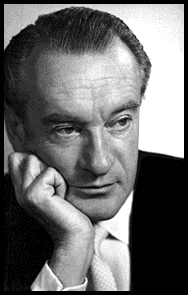
The most elegant man I've ever seen
    On the next Saturday morning I sat next to Mrs. Robb, in the lobby of Carnegie Hall, crying, as we waited for Laura to have her acting lesson with Miss Martin. Sick with disappointment I sobbed aloud as Mrs. Robb tried to comfort me. I had missed out on the golden opportunity of living in the sophisticated universe of Judith Martin, a person who recognized the greatness inside of me. 
    Suddenly the most elegant man I’d ever seen, tall and handsome in a dove-gray suit, was towering before me, looking down at me with questioning eyes. I looked up with my tear-stained face and he said something like “Why are you crying?” I told him that I wanted to be an actress but my parents were blocking this from happening.
    He spoke to me just as Miss Martin did, with patience and interest. And in the most distinguished voice I’d ever heard, the man told me all I would ever need to know about acting.
    “If this is what you truly want, you will be an actress,” he said.
    He said that no matter what my parents or anyone else had to say about it, I would be an actress.  If it was truly my fate it would happen because I would make it happen. Acting would be the only thing in the world I would care about. Nothing else at all would ever matter to me. It would be the one and only focus of my heart and my soul.     
    I listened, mesmerized, and silent, knowing that acting would never claim that much of me. Ever. Then I asked if he was an actor. Yes, he said. His name was George Sanders. He patted my head and strode off into the crowd.
    I dried my tears. Presto! My broken little heart was broken no longer, because suddenly I knew, with absolute certainty, that I did not want to be an actress if it meant abandoning every other deliciously fascinating thing in my life.

    One of my favorite movies is All About Eve, featuring my great teacher George Sanders. Clearly, he loved acting, at the exclusion of all else. How brilliantly he plays the heartless cad! Who else could do that without looking silly? Who else but a passionate and seasoned actor like George Sanders.
     What I did not understand that day in 1958, but I do now know, is that he was telling me something else, too. He was describing the agony of having no other choice.
    “Are you one of us?” he seemed to say. “If not, recognize it now and get out of our way.”
Fasten your seat belts, it's going to be a bumpy night. All About Eve
    This week my husband, who loves theater, is reading a book by James Lipton, host of Inside the Actors Studio. Lipton recounts his relationship with George Sanders, and Sanders’ heartbreak when he learned his wife was dying of cancer. Sanders cried like a baby and begged to be released from the show in which he was starring. His wife did die, and five years later, Sanders died, too. By his own hand. But before he did, he penned this note:  “Dear World: I am leaving because I am bored. I feel I have lived long enough. I am leaving you with your worries in this sweet cesspool. Good luck.”
 

Thursday, April 14, 2011

You're The Cream In My Coffee

My morning cup 'o joe .  . . or whatever it is now.
Cancer changes you. When I was diagnosed with throat cancer, I was a swiller of black coffee. But radiation treatment left my throat ragged and raw, and black coffee no longer worked. So I experimented with various combinations of agents designed to mute black coffee’s shrill edge. I tried milk, half and half, heavy cream, fake sugar, real sugar, and then something new, something I call “Faux Cream.” 
    Deep in the darkest throes of cancer treatment, I found myself with a totally foreign problem. I lost interest in food. I lost an enormous amount of weight. I wore the same size jeans I had at age 20 -- which are no longer as flattering at age 60. Considering my body to be thinner than he believed to be healthy my oncologist suggested that I eat something preposterously fattening every day, like cheesecake, he suggested. Ugh, I said, not even on a good day! So just what does taste good to you? he asked. Coffee with Faux Cream. You know - the stuff they advertise on TV commercials with healthy-looking couples sharing steaming mugs of coffee, heavily doused with faux cream -- just like in a sophisticated coffee shop! I love that stuff! I told him. So drink lots of that, he said. Surely it’s full of calories.
    Suddenly Faux Cream was available everywhere! At the supermarket, of course, but also at CVS and Walgreen's, and even at the hospital where I spent four weeks having chemo infusions. My friend Brigitte, a secretary, regularly delivered to me large styrofoam cups of coffee laced with Faux Cream. They served it in the hospital cafeteria! For many weeks it was the only thing I could swallow.
Flowers in a Nescafe jar
    For months afterwards, I continued my love affair with coffee and Faux Cream. I dreamed of it every morning as I dragged my recovering body out of bed and into the kitchen. As my health and my appetite returned, I felt that I should go back to unadulterated coffee. To celebrate this return to normalcy my husband gave me a one-cup coffee maker for Christmas. Since I am the only coffee drinker in the house, it made sense that a single “pod” of coffee, expressed through the one-cup machine, would efficiently provide me with a freshly brewed cup of steaming hot coffee every time. There was a stunning array of flavors of pods to choose from. And I tried a dozen, at least, before I realized that the one-cup coffee maker, with its promise of great, black coffee was, in fact, so much weak tea. What makes my one-cup coffee maker such a flop is it’s inability to keep the coffee steaming hot. So those little cleverly designed pods of coffee grounds just didn’t have a chance to express themselves. At 50 cents a pop I want an expressive cup of coffee, capable of standing on its own, without the crutch of Faux Cream.
    Over a restaurant lunch one day, after I’d ordered my second cup of black coffee, a friend who is a doctor told me that he’d read that black coffee is believed by some to have a toxic effect on the tissues of the throat. Considering what my throat tissues have been through, it was a short trip back to my beloved Faux Cream, which comes in nonfat or non-sugared versions. Now my place of work features a great stainless steel box called the “Cow”, with three udder-like spouts, each delivering a different flavor of Faux Cream. Because of the exploding popularity of Faux Cream, the cow is often dry, particularly since it was discovered that the vanilla flavor is wonderful on instant oatmeal. Which led me to reason that instant coffee might serve as a cheap and flavorful conduit for the real deal, Faux Cream. Did you know Cafe Bustelo comes in instant? Yummy. Nescafe, I discovered online, is considered by instant coffee connoisseurs to be the best instant and I’ve found that the empty jar makes a dandy flower vase.
Celebrating my birthday with black coffee
He's the cream in my coffee
    The other day I was shopping in Winn Dixie and found this deal: Buy one bottle of the brand name Faux Cream, and get one Winn Dixie brand, same size, same flavor, for free. I did it. And yes, it tastes just as good as the brand name stuff. I’m sold. Now I get my daily caffeine via coffee crystals, enlivened with Key West’s own boiled tap water, laced with Faux Cream. I awaken daily with a Pavlovian yen for this tasty elixir.
    Yesterday was my birthday, a special occasion. We went out for breakfast. The day was bright and hot. The crepe was fine. But the coffee, brewed strong and swallowed black, while gazing into the sky-blue eyes of my lover—that was perfection.


Check this out. Copy and paste this address in your browser for the coffee song that put Marlene Dietrich in the movies.

                     http://youtu.be/mRpl4crn6a4

Thursday, April 7, 2011

Why Youth is Wasted on the Young

A case of arrested development. Miguel and Michael clowning for my camera.
My one and only son Miguel and I were driving around Gainesville the other day. Miguel was reminiscing about his years there, pointing out various apartments he’d inhabited and locations of crazy experiences he’d had in them. I remembered visiting one of his places back then and being awakened by a phone call at 5 a.m. Miguel was asleep. I told the young lady looking for him that her pre-dawn call was in very poor taste. She did not seem impressed by my scolding.
    “Just around this curve there’s a straight part in the road,” Miguel said. “And then a bridge. We used to love speeding right through here.”
    He told me that once he’d nearly gone to jail for speeding at this spot in the road. He’d been sneaking drinks in a club. The way home took him through the aforementioned straightaway. With youthful exuberance he’d floored the gas pedal, and sped down the flat toward the bridge. On the other side of the bridge, a cop cruiser awaited.
    “Either you’re stupid or you’re drunk,” the cop had said.
    Irretrievably caught, Miguel confessed to being both stupid and drunk. When the cop asked him how much he’d had to drink, Miguel replied “just one or two,” like they do on Judge Judy. The legal drinking age was 21. He was 19.
    “I could take you to jail right now,” the cop said. “But since you’re honest and reasonable, I’m gonna give you a big ticket instead.” The speeding ticket cost him $285. 
Miguel and me. New Years Eve, 2010.
    The 32-year-old Miguel of today chuckled ruefully at the foolishness of the brash young man he’d been. Then we talked about how kids do stupid things, and what a treacherous time youth is for even the best people.
    “What will you do if someday your own son comes home with a $285 ticket for speeding over that same bridge?” I asked him.
    He sat silently, mulling over my question.
    “Maybe nothing like this will happen to your kid,” I said. “Maybe your own son will be smarter at 19 years old than you were at that age.”
    “Mom,” he said, “that's not possible.”

    He’s right. Kids do behave foolishly and impulsively and dangerously and short of tying them up at night there’s not a whole lot we can do about it. Youth is fearless. Young people live with the impunity of youth, the vast majority of them surviving their teens and growing up to become the tortured adults we call parents. I once read that this sense of reckless abandon is necessary for the human race to advance. No doubt a teenager invented the wheel. An adult would have thought such movement way too risky. The Wright brothers were teenagers when they endeavored to fly. Romeo and Juliet did it all before they were old enough for learners’ permits. Adults don’t take those kinds of risks. Only dumb kids do, and we who love them must bear witness to their absurd confidence in their own invincibility.
    “Why did you do that?” parents ask their misbehaving kids.
    “I don’t know,” their kids truthfully answer.

    The next morning, back in Key West, my husband Michael and I took our breakfast out onto the deck. As we ate I told him about the story Miguel had told me.  I said I felt like having a kid was like having a chunk of your heart out there in the world, alone and unguarded, naked and vulnerable on this ever more terrifying planet. I told him that parenting was the worst job in the world.
    “You can’t stop them from making the same universally ridiculous mistakes that you made,” I said. “They don’t hear you when you can see exactly what they’re doing wrong and tell them that you’ve already been down that road they’re traveling and the road is a dead end. You have to stand by and watch them being stupid, getting hurt, having their hearts broken, suffering . . . doing all the dumb things they don’t have to do if only they’d listen to you.”
    The sun was shining. Palm fronds clacked lazily in a soft breeze. Two doves cooed on a wire over the church across the street.
    “So now you know how God feels about his children,” Michael said.

Monday, April 4, 2011

Light My Fire

A few good men: Mike is in the black shirt. His son, and mine, is Miguel, in red,  In plaid: my husband Michael. Also standing, Grampa Mike.  If you get a chance to dance with a Cuban, do it. Thirty years later you may find yourself taking a sweet photo like this one from my collection.
Last Wednesday my son Miguel received word that his father was critically ill and hospitalized in Gainesville. We thought of driving up but Miguel said he’d go nuts driving all that way, not arriving till the early hours of the following day. So we hurriedly jumped on a plane and headed to his bedside. My ex was very ill, and we were glad we’d gotten there quickly. A crowd of family and friends, and his girlfriend Beni, as well as our son Miguel and I were there to see him through the scary night. He made it.  When I was confident that he was getting all the care and support he needed, and that he was not going to die, I decided I needed to get back home, back to my job on Friday and my PET scan on Saturday. Bad weather grounded flights out of Gainesville. So I rented a car. On Thursday I didn’t blog like I usually do. Instead I drove. And drove.
    Gainesville is 500 miles from Key West and I spent many hours on the road with nothing but the radio for company. Normally I’d be armed with a well-stocked iPod, or a talking book, or a pile of CDs. But, like I said, this was an impromptu trip and I was not prepared. I was alone, with my thoughts, and some scary interviews about the state of the world on National Public Radio. My first goal was to outdistance the horrible weather. I did. I drank fast-food coffee and felt my throat getting sore.
    Every hour or so my son called to check on my progress and update me on his father’s condition. My heart was aching for him, his worry over his father’s condition, his frustration with the confusion over what exactly was wrong with him and what was going to be done about it. The doctors and nurses seemed to have no clear answers. Everyone in his life responded differently to the shock of Mike’s illness. His father, Miguel’s grandfather, broke down and sobbed when he arrived at the hospital to see his son critically ill and barely conscious. It tore everybody to bits to see the old man so sad. The thick mesh of love we've woven through the years, the affection we share, saved us like a net when we wobbled on that awful tightrope of not knowing.

    I know a lot about being ill. I’ve been there and done a lot of that in the last couple of years. Cancer treatment is brutal and horrible to endure. But what hurts more than being ill yourself is to see someone you love suffering. I'll swap witnessing a sick loved one for being the sick loved one any day.  It doesn't hurt nearly as much. Believe me. Seeing my ex husband in a hospital bed was a sickening shock. And it hurt me deeply to witness my son’s torment and suffering. There was nothing I could say to assuage his grief. We talked about funny stuff his father had said or done. We talked to calm ourselves.
    Meanwhile, back in Key West my husband Michael -- yes, I married two guys with my same favorite name — jumped each time the phone rang, nervous at what the news might be. We talked throughout the day, too, about the fun and good things that made our lives sweet. My son told me that my ex was asked if he knew his last name. He said he thought it might be “Turner.”  It isn’t.
    “He thinks he’s Ted Turner,” I told Michael, “that’s why he spends money like he’s got lots of it.” 
    A traffic jam in Hollywood cost me two hours. I was hungry and thirsty and miserable. I had to pee. I wondered why you don’t see more people peeing on the side of the road in such situations. I remembered my mother saying, when I was a little kid, that if you peed on the side of the road you’d get a sty in your eye. Did she make that up? Or did her mother tell her that? I imagined creating a portable privacy potty, made of canvas, that could easily be erected on the side of the road to accommodate the aging bladders of people like me during traffic jams. They could come as standard feature in new cars. I see the ad on Saturday Night Live . . .

    As the sun was setting I entered the Keys and my gloom lifted ever so slightly to be back on the islands, on familiar ground. I found Keys radio stations to listen to. I watched the mile markers zip by. And as they did, I realized that my own life was zipping past, too, and that these terrifying episodes, growing more dire as we grow older, are the mile markers on the road that is my life. I ached to talk to my mother. But she died in August. I wanted desperately to talk with my friend Jennifer, whose children gleefully call us BFFs. But Jennifer was felled by a stroke in September and has not yet recovered to the point where she can talk to me in the sweet, steady voice that has steered me though so many rough spots along the way.
    Then my mind moved to that PET scan, the ultimate cancer check-up, looming on the horizon. What if it was bad? How in the world would my son handle that? Was Miguel about to become an orphan?
    On Big Pine Key, at the place where you slow to 35 miles per hour to avoid hitting a Key deer, two cars tore past me at lightening speed and another tailgated impatiently. My mood darkened. Is nothing sacred?
    Then, salvation. "Light My Fire" came on the radio. Jim Morrison. That voice. That song. That time, when music lifted me up and out of the darkness, and the agony of my '60s adolescence. Please, I prayed to the Gods of Rock 'n Roll, please, don’t let it be the abbreviated radio version. Let it be the long version, the album cut. And if it is the original version, I thought, I will know that everything is going to be OK. We will abide, just as music abides. We will live forever, just like Jim Morrison.
    It was the long version. I made it home. I made it to work Friday morning. I made it to the PET scan on Saturday morning. I did have a sore throat by then, but, the test proved, I didn’t have cancer. I don’t have cancer. Miguel’s father has remembered his name. Miguel’s sunny world is intact.  And so is mine; my fire burning bright.

        Listen to this. Have yourself a Doorgasm. Everything is gonna be all right.