Wednesday, April 3, 2013

The Dark Side of the Moon


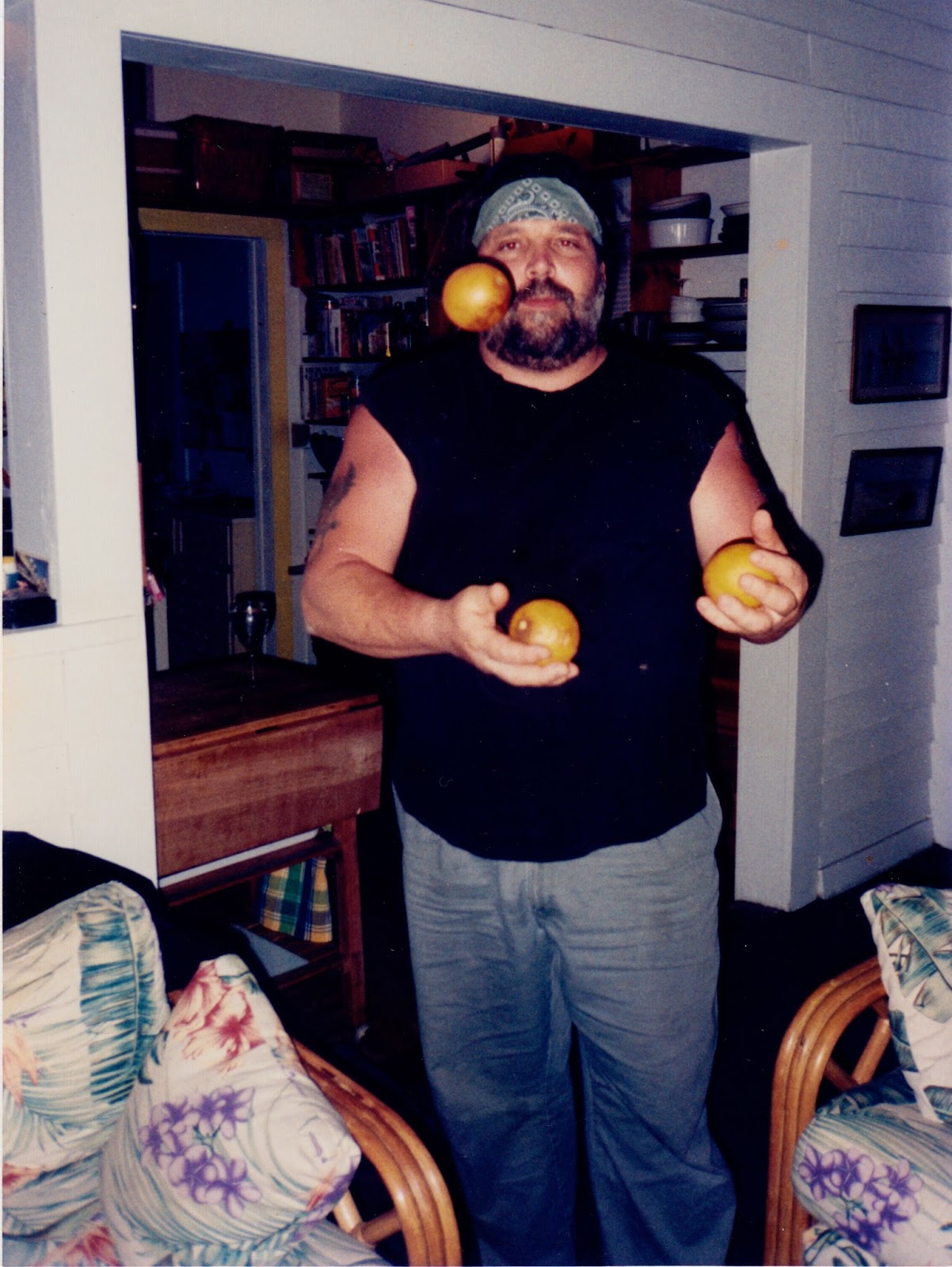
RIP Victor Latham  (1973) 
Victor Latham died on Easter Sunday. I remember Victor well, and we have been Facebook friends for a long time. My ex-husband and Vic played a lot of racketball over at the Key West High School courts back in the day. I wrote this column about the Full Moon Saloon in the Miami Herald in 1993. My husband Michael suggested that we re-print it today. So here it is:

The Dark Side of The Moon

    When I read in the paper that the Full Moon Saloon was closing its doors for good, I felt as if I were reading the obituary of an old friend, an old friend with whom I'd gotten into lots of trouble. True, I hadn't been in the place for years. Nonetheless, I'm sure I'd fulfilled my quota of lost weekends there and certainly qualified as a bonafide "Full Moonie."
Full Moon Saloon T-shirt

    I quit the place because I quit drinking 8 years ago,  and though it was always a fun place to eat a fish sandwich or make a midnight rendezvous, none of that felt the same as it once had without a couple of the house's overly generous cocktails to guide you 'round the dark side of the Moon.
    But sobriety isn't the only thing that has kept me away from the Moon. Some of the darkest moments of my life happened there. 

    My first marriage ended at the Full Moon eleven years ago. The comedy team of Mack and Jamie was performing that night, and my husband and I had gone there to celebrate our fourth wedding anniversary. I wanted to see the show, but the waitress told us it was sold out.
    "Sorry, honey," my husband said, as if he meant it.
    Victor Latham, one of the owners of the place heard that we, two of the Moon's most dedicated patrons, wanted tickets to the show. He came to our table and offered us tickets as an anniversary gift.
    "No thanks," my husband said. "See, I'm expecting a phone call. We gotta get home."
    It was a lie. There was no important phone call expected; I was sure of it. Anger sizzled through me like an electric shock.
    "That's it," I said, not quite believing the words suddenly flowing from my mouth.
    "I want a divorce. "
    "Don't say it if you don't mean it," he said evenly.
    I meant it. Two weeks later I moved out of his house.
The Full Moon Saloon fish sandwich. Perfection!!

    A year later I had a new lover. He managed a theater and told me how much he despised working with the actors there, whom he bitterly described as childish, demanding and self-centered.
    One night he phoned me to break a date we'd made earlier that day. He said he had to work. My roommate and I walked over to the Full Moon for a late supper. And there, holding the hands across the table and gazing deeply into the eyes of one of those childish self-centered actresses about whom he'd complained so bitterly, sat my overworked lover.
    He never saw me standing there. He never saw me crying into my Caesar salad. In fact, he never saw me again.
    I was thinking about those sad moments last night, when my husband Michael, his buddy Chuck Krumel and I drove past the darkened Full Moon Saloon. We'd just had a great dinner at El Siboney, and were full of good cheer.
    "Boy oh boy, I raised a lot of hell in that place," I said. "And now it's closed."
    "They had to close," Chuck said. "All of their customers are either in jail or in recovery!"
     "Maybe AA could move into the building," I said. And we laughed.

The songwriting team of Chuck Krumel and Michael Keith

     I told them about the night I decided to divorce my first husband. The memory just didn't seem very sad anymore. It just seemed awfully long ago.
    "He wouldn't even see Mack and Jamie with me!" I said. "He wouldn't even let me laugh."
         Around the time I first met Michael, Mack and Jamie were at the Pier House. I asked him if we could go and see the show. He said “Sure. Let's have some laughs." It was the right answer. So, I married him.
    I was in the back seat, and I couldn't see Michael's face, but I knew he was smiling as he drove our car down Simonton Street and I watched the Full Moon disappear into the darkness. 

Update, April, 2013: My-ex husband and I remain great friends. My cheating lover married that actress. They are divorced now, too. Chuck Krumel, who was larger than life, died of lung cancer in 2009, a heart-breaking loss to many. Michael and I are still laughing, and still married. And Vic Latham has gone to the moon.


Sunday, March 24, 2013

Happy Easter, Survivors!

Reformed cancer survivor with morning smoothie.  
I was shopping in Publix. I was at the deli counter to buy sliced ham. A clerk told me he’d be right with me. I told him to take his time. He was finishing up an order of sliced corned beef, he explained.
“Here,” he said. “Try this corned beef. It’s so lean! No fat at all!”
     He laid out two big slices on butcher paper. It was delicious. I don’t eat a lot of meat. I don’t love meat. But he was so joyful, so enthusiastic, I had to eat the corned beef.
    “Hey,” another customer said. “Are you giving her samples of my corned beef?”
    “Oh! this is your corned beef?” I said. “Thank you. It’s really very good.”
    “I’m glad you enjoyed it,” she said, chuckling as she headed off with her cold cuts. 
    Before I was finished chewing the beef, the joyful man pushed another sample toward me. It was ham; two big slices on another piece of butcher paper.
    “Try it,” he said. “See if it’s what you want.”
In truth, I’d had enough. I was buying the ham for my husband, Michael, the Southern-bred meat eater in the family. But, again, the guy was so sweet and happy, like an old time butcher in a little town grocery store. So, with my other hand, I picked up a piece of ham. Now I was a two-fisted meat eater.
    “Are you June Keith?” a woman new to the scene asked. 
Easter, 2011. Puleeese let my hair grow back!
    I know this woman slightly. She is a nutritional consultant, a guru of what to eat for maximum health, often in the local press. I think she has a radio show, too.  She is a great advertisement for her brand of healthy eating. She is bright-eyed, lean, and youthful. And there I stood before her, with two fists and a mouth full of meat.   
    “How are you?” I mumbled, through the salty beef.
    “I have cancer,” she said. “I just found out.”
    Dear reader, I hope you are seeing the tragedy and the comedy in this little slice-of-life drama. I, a cancer survivor, am stuffing my face with nitrate-laden, fat-streaked, carcinogenic meat, while this lovely woman who probably last tasted meat in 1968, tells me she has cancer.
    It seemed wrong to eat that meat as she told me her story. She is going on an extreme diet, she said, a diet that eliminates any carbohydrates whatsoever, because carbohydrates turn into sugar in the body, and cancer feeds on sugar.
My beautiful, young and healthy Mennonite neighbors in Nova Scotia, picking strawberries.
    I become very nervous when people tell me they plan to cure themselves of cancer with a severe diet. If only it worked that way! But that isn’t her plan, thank goodness.  She only wants to do what she can to discourage the cancer. She’s going to doctors to handle the job of killing the cancer cells. I told her I’m sure that’s her best chance for a cure.
    “I’m cured now,” I said. I told her it’s rough. My oncologist told me, at the very beginning of my treatment, it would be “no walk in the park.”  No, it was a walk in the valley of the shadow of death. But I survived. And she will, too. I’m sure. We will both live on to die of something other than cancer.
This opera singer lived to be 99 years and 9 months old. Smoking Chesterfields. Go figure.
    At home, when I told the story of our meeting to Michael, I told him that I am often amused at how arrogant we humans are in the face of our destiny. Before there was chemotherapy and radiation and PET scans, there was nothing but a person becoming sick, then sicker still, and then dying. This is how we’re made. Like a flower, that with enough water and sun, flourishes on earth. Till it doesn’t. And so it is with humans.
    I had a big checkup the other day with the oncologist. I thought it would be bigger than it actually was.  He felt my neck. Looked down my throat. Studied my blood test results, my lung X-ray and my PAP smear, and told me to call him if I found any hard lumps in my lymph nodes. No more scans. No more tests. No more regular six-month checkups. Today, I am cancer free, and beyond the reach of anything more modern medicine can do to me.
    The doctor did tell me that since I’ve had cancer once, I have a greater chance of getting cancer again. But hopefully, he added, the cancer will never come back and I will die of something else.
    Like what? Being hit by a bus? A heart attack? Old age? Stress brought on by worrying about my cancer returning?
    “The good news,” Michael said, “is you’re too old to die young.”
    I’ve already performed the miracle of rising from the dead. And very soon the burden of my medical bills will be turned over to Medicare. So pass the ham. And the marshmallow Peeps. And the chocolate bunny. And the Cadbury eggs. ‘Cause nobody dies on Easter Sunday.

Thursday, March 7, 2013

How To Live Forever


Tennessee Williams with his beloved bulldogs
The other day Michael ruefully commented that the 30th anniversary of Tennessee Williams’ death had come and gone without fanfare in Key West, the town where Williams found solace and retreat. This does not sit well with Michael, for whom Tennessee Williams represents all that is holy in theater. On the day the news of Williams’s demise burned across the newsroom teletype machines of America, Michael was in Key West, rehearsing a play at a local theater. Some of the actors beside him that day had worked with Williams, and, some had even known him, at least peripherally. “Peripherally” seems to have been the only way that anyone knew Tennessee Williams in those final years of his life.


Williams’ reputation was as great a presence in Key West back then as Williams himself. There was the story of Tennessee Williams going to the dentist, in a state of extreme paranoia, to be fitted for a partial plate that he never wore because he died before it was ready. The dentist kept the plate as a souvenir, pulling it out of his pocket at cocktail parties, and recounting the stories of the great playwright's visits to his office. There was the story of the Tennessee Williams painting auctioned off at a Historical Society fund-raiser, a little sketch delivered to Richard Heyman’s Gingerbread Square Gallery, where Williams’ paintings were sold. The work, donated for the auction, featured Williams’ trademark signature, “TW.” It sold to a Miami couple for $750.  After the auction Williams, who’d been out of town and missed the auction, raged that the painting was a forgery, created by his friend, the great artist Henry Faulkner. Williams demanded to have it back. Richard Heyman, who’d brokered the deal, explained the story to the Miamians. Henry Faulkner?! That made it even better, they said. But Williams wanted the painting returned. So Heyman refunded the $750 out of his own pocket. The Miamians reluctantly returned it to Heyman who returned it to Williams, and the painting was never seen again.
Quintessential Henry Faulkner


There were sightings of Williams and Truman Capote at the Pier House, and at Captain Tony’s Saloon. One night, as he wobbled down Duval Street with a friend, drunk, singing hymns, he was shoved around a bit by late-night locals. Within 24 hours the greatly exaggerated reports of the aging playwright’s vicious beating circled the globe, as the world, always ready for dirt, hungrily gobbled up the news of another fallen idol. When asked by a reporter about the scuffle months later, Williams wryly suggested that the Duval Street ruffians had probably been a pair of New York drama critics.

Henry Faulkner with sailors

Williams named this "Fairy in a Wicker Chair"
On an island of Tom Wingfields, Stella Kowalskis, Big Daddys, and hot tin roofs, Tennessee Williams, and, for a while, his lobotomized sister Rose, easily fit in. In his later years, when drugs and alcohol fueled his terrible decline, and he only coasted on the fumes of the dazzling success of his youth, Williams devoted himself to exploring Key West’s seedy underbelly. Henry Faulkner gave him painting lessons in exchange for Williams coaching him in poetry writing. Faulkner was also a procurer, who delivered hopeful young men to Williams’ Duncan Street cottage where they would pose for Williams’ paintings and deliver sexual favors, in exchange for a boozy dinner or two and the chance to say they’d been a lover of Tennessee Williams.


Frankie and Tennessee at cocktail time. Who do you suppose received this photo and message?


Merlo and Williams at 1431 Duncan St.  Check out the body language . . .
I knew one such man. His name was Douglas. He met Tennessee Williams when he was sent by writer Dotson Rader to meet Williams’ plane at LaGuardia and deliver him to his apartment at the Hotel Elysee, where the welcoming party was well underway. Douglas recalled that Williams seemed frightened, disoriented, and gobbled pills from the pocket of his tweed jacket on the drive from the airport into the city. Few young men, Douglas explained, spent more than an hour or two in Williams’ bed. And fewer still were invited for a second visit. There was one special person in Tennessee Williams’ life. That was Frank Merlo, a handsome Italian he met in Provincetown. For many years Merlo was Williams’ devoted caregiver, friend and lover. But the crazier Williams became, the more he detached himself from the people who most cared for him. After nearly twenty years, the years he called the happiest of his life, he dumped Merlo altogether. A year later, as Merlo lay dying of lung cancer, Williams wept at his bedside, crying, “I want my goodness back.”


"Frankie" by Tennessee Williams
There was a reading by Tennessee Williams at David Wolkowsky’s Sands Beach Club in the winter of 1982. I went with a group of friends to see Tennessee Williams. It was a cool night and the beach was packed with fans. I remember the fantastic excitement, the shivery thrill of being on that beach, waiting for all to be in place – the microphone, the chair, the script, his glasses – so the reading could begin. The wind was blowing off the ocean and Williams was perched on a pier, many feet from his audience. Finally he began to read in a thin, soft voice that was impossible to hear. He stopped. The microphone was adjusted. He tried again. But minutes after the reading had begun, it was over.  Williams was led off of the pier. He appeared to be unsteady, with people, one on each side, holding his arms. It brought to mind memories of Carl Sandburg reading at Kennedy’s inauguration, on a bitterly cold day. Or the Pope visiting Manhattan, so insulated by his handlers it was impossible to see the real man in all the throngs of people crowding around him. How can one aging human being, albeit a genius human being, satisfy the longings of so many? Is it so difficult to imagine this mass adoration driving a person mad?


Burt and Anna in Key West

A year or so after that night on the beach came the news of Williams’ death. On that day the Key West Picture Show theater on Duval Street, in a show of enormous respect and compassion, offered ‘round the clock free showings of The Rose Tattoo, Williams’ one and only happy-ending play, made into a film here in Key West in 1955, when Williams was at the height of his success, before he became victim to what he called “the tragedy of success.” Michael was there at the theater that day. And so was I. But we had not yet met. That happened a few years later. And when we met, we found common ground in our mutual love of Tennessee Williams’ plays, and in our worshipful study of his life and times. The genius of Tennessee Williams is like a diamond in candlelight, every glint and glimmer translating into a new slant on ... everything.


It’s all so delicious, picking over the bones of Williams, the salacious and the sentimental details of his nomadic life, made all the more tasty because we have in common with him this island that he called, and we call, home base. Tennessee Williams, his sister Rose, Henry Faulkner, my friend Douglas, are all dead now. Soon all of us who remember the tales of Williams, the Key West citizen, will be gone, too. But those born of the bright light of Williams' genius – Maggie the Cat, Blanche DuBois, Chance Wayne, Heavenly Finley, Alexandra Del Lago, Sebastian Venable, Val and his snakeskin jacket, (a character all its own!) live on forever. Ageless, as truth is ageless. And Tennessee Williams, the playwright, lives forever, too, right along with them.

Saturday, January 26, 2013

Eyewitness To History

Michael Keith checking out his platter collection at WGST

Back in the early '60s I was a kid in junior high school in New York and my future husband, Michael, was working at Atlanta’s Radio WGST. In addition to his music program, he created a daily half-hour news show. It changed his life.  Michael had grown up in Greenville, South Carolina, in a world with very clear boundaries, in a segregated society. And while my world contained people of color, and the civil rights movement was something happening far away that we only knew from the six ‘o clock news, Michael did not go to school or even to church with people of color. The only black people he knew were the maids who worked for his family, and sometimes, the children of those women.

The Varsity Drive-in: WGST news team's favorite lunch spot in 1963.

      Do you remember where you were when you heard the news of JFK’s assassination? Michael does. He’d just had lunch with fellow radio man Dan Akens, at the Varsity, a drive-in joint on the Georgia Tech campus. The Varsity, which exists to this day,  featured car-hops with big personalities, like the one who for fifty years sang the menu to his customers, and the young Nipsy Russell who wore crazy outfits and entertained his customers and later became famous as a comedian.
President Obama ordering a burger at the Varsity today

     With President Kennedy’s election came awareness of the civil rights movement. It was the central theme of the local news in Atlanta. And Michael found a way to make it pay. The ABC Network paid for "actualities," short clips of newsmakers like Dr. Martin Luther King and Julian Bond expressing their views via the media. Naturally civil rights leaders like King made themselves available for reporters. And Michael, who received a tidy fee from the ABC network for each actuality used, was happy to help the civil rights leaders like King and Julian Bond get their message out. He spoke with them, and recorded their comments, regularly. Of course Michael also interviewed the Grand Dragon of the Ku Klux Klan, because it was his job to balance his reports.  And ABC News paid him for those remarks, too.
The house in Atlanta where Martin Luther King, Jr. was born and raised.
     Michael was very naive then, though smart and ambitious, and possessed of an amazingly mellifluous voice just made for announcing. In Atlanta, reporting the news, he began to question the core beliefs of the society in which he’d been raised. Eugene Patterson, editor at the Atlanta Constitution, who died last week, wrote stirring editorials on the subject. Michael read them, and was swayed. After the Birmingham church bombing, in 1963, Patterson wrote an editorial so powerful that Walter Cronkite invited him to read it on the national TV news.

     “Patterson and others like him were taking the lead in standing up to the extremists who endorsed violence to maintain segregation,” Michael remembers. “It made you start to think. How can we allow discrimination to go on? How can people kill children? This isn’t America. The scales began to fall from my eyes when I read Patterson. I watched King’s "I Have a Dream" speech live on television, and I thought how can we deny people their right to the American dream because of the color of their skin?  I decided it wasn’t right. I wouldn’t be that way.”
   Then came the ah-ha moment.
"....explain to your six-year-old daughter why she can't go to the public amusement park that has just been advertised on television, and see the tears welling up in her little eyes when she is told that Funtown is closed to colored children." (from Letter from a Birmingham Jail)
 
     "One day on the radio in Atlanta I heard a black preacher describe prejudice as 'that blind vampire of the mind that sucks the red blood of healthy hopes.' Today, I can't recall that preacher's name. But his words stuck with me.  I thought: how can people who are just like me, wanting to get ahead in the world, be put down and disadvantaged all of their lives for something they cannot control, and are not responsible for — the color of their skin? The injustice of it was brought home to me by that preacher’s graphic words."

     Michael wasn’t a leader, and he didn’t aim to be a hero; he was a just a cub reporter, with a wife and two kids to support. But he knew where he stood.

On his many years of teaching Julian Bond, (shown here) recently had this to say about his students: "I hope they learned that the civil rights movement was a movement of ordinary people, many of them just like these young people who were sitting in my class."
    Michael was on the scene in 1964 when three black high school boys decided to force their way into the Pickrick Cafeteria in Atlanta. The Pickrick’s owner, Lester Maddox, adamantly refused to allow black people into his restaurant, in spite of the newly passed Civil Rights Act. The media had been alerted to the planned confrontation. A mob of angry segregationists had assembled. Michael approached the three young men and said to them “You need to think this through. You’re gonna get hurt. This isn’t the way to do this.” The students retreated. And on the front page of the Atlanta Times the next day, there was a photo of Michael, microphone in hand, speaking to the black students.  He wasn’t being a hero. He was being practical, he says today.

    “I knew those guys were gonna get hurt,” he says. "It was as simple as that.” Weeks later a better organized group of college students hired an attorney to challenge the illegal segregation of the Pickrick. And they won.  Rather than integrate, Maddox closed his restaurant. On the wave of that publicity, he was elected governor of Georgia.
   
 He didn't go to jail. He went to the Governor's mansion.
     On one occasion Michael interviewed Martin Luther King in person. King had piercing eyes, Michael remembers. King was very angry that he was being criticized for his opposition to the Vietnam War. Michael recalls King’s anguish, and also the absolute courage of his convictions.

      Recently I spoke with Reverend Robinson of the Big Coppitt Baptist Church. When the pastor mentioned Reverend King, I told him that my husband had interviewed the man in the '60s.
    “I bet that is a day he will never forget,” Reverend Robinson said.
    I told Michael at dinner that night.
    “He’s right,” Michael said. "Who could?"

      I love talking with Michael about those times. Martin Luther King, Jr. was assassinated a few months before I graduated from high school. By then Michael was out of the news business, and a student of history at Furman University. He was no longer naive. He knew how he felt and how he wanted to live.

     Martin Luther King, Jr. is a hero in our home. Our son Miguel, who shares a birthday with King, has grown up knowing that. When Miguel was a little kid he and Michael sometimes talked about those days before the Civil Rights Act, when black people were not allowed in stores, restaurants, schools and churches. It was astonishing to Miguel, a kid born and raised in Key West, to know that his parents had lived in those times and witnessed that world.
The speech heard 'round the world:  I Have a Dream. Washington, D.C. 1963.  Fifty years ago!


    “You know,” Michael said, “someday Miguel will tell his children about a time when people were discriminated against because of their sexual orientation. That they fought for the right to marry the person they love. And you know what? Miguel’s children will be astonished to hear that.”


Thursday, January 10, 2013

Coma, Part 3


Jennifer: A very fun girlfriend.
My dear friend Jennifer turns 44 years old this month. But I’m not sure this birthday truly counts. She hasn’t been fully engaged in the activities of living for some time now. Over two years ago Jennifer suffered an aneurism in her brain. She survived, but was in a coma for a long, long time. We who love Jennifer waited for days, weeks and months to know if she would come back to us. And nearly five months later, just around the time of her January birthday, she opened her eyes, eyes that had last viewed a warm September evening in Key West. She knew us. She came back to smile and wave and do something I call the Jenny Shrug. I know this because Jennifer and I have spent countless hours talking about our lives, the lives of our children, and the meaning of it all. I know the precise hue of resignation the Jenny Shrug implies. When she did it again after five months in a Sleeping Beauty-like coma, I cried with relief to see her personality unmistakably present.

     But Jennifer cannot walk, and she loved to walk. She cannot swim, and she loved to swim. She cannot cook and she loved to cook. She cannot talk and she loved to talk. She cannot write for hours each day in her tiny, precise print journaling the nuances of her days like a miner panning for nuggets of gold, hiding in plain sight. Jennifer cannot dress her beautiful sleek body or drive her children to school. She is hostage to bed and chair. And house. Outside of her house there are germs and cars and curious eyes to be protected from. In the lovely, light-filled house she shares with her husband Joe and her daughters Sophie and Tessa there is comfort and safety.  There is shelter, too, for their big dog, and their books and their piano, their computers, their hopes and dreams. There is a perfect garden, too, where Jennifer toiled happily and often, nurturing her plants just as she so carefully nurtured her family and her work.
Jennifer: A wonderful mother.
     The last thing I heard from Jennifer, before IT happened, was an email in which she asked me to write a letter of recommendation for her grad school application. I was in Nova Scotia when I read it. Two days later, Jennifer was in Miami, in a trauma center, far from her safe place, entranced in the most awful kind of way.

     How in the world does this happen? How does a beautiful and stately and thoughtful woman, indeed a fine specimen of our species, suffer such a thing as a brain bleed? How does God let this horror befall a good Catholic woman, so deeply devout, when an ambulance approaches she pulls off the road to say a prayer for the suffering?  We were told there had been a malformation in her brain, and that it had been there, stealthy, like a ticking time bomb for all those years of her life. This is fantastically rare. This makes no sense at all. The weight of it, if you think about it long enough, can suffocate you. The injustice of it can make you angry as hell, and vengeful. But upon whom do you wreak your revenge? Who is to blame?
Jen & Fam:  Trick-or-Treating with Stella, the Dog
     I remember a time when we were in a motel in Ft. Lauderdale where we’d gone to escape a hurricane bearing down on Key West. For Jennifer’s little girls it was an adventure. One morning, before the sun was up, I heard the girls stirring. Jennifer was asleep. Tessa gently shook her mother’s shoulders, and asked her to read to them. And so Jennifer read the book as the two little girls snuggled against her, one on each side. I remember thinking at the time how extrodinarily patient she was, how giving, how kind, to immediately respond to her babies. In the same situation, I know I would have said to my own little one: “I will read later. When I wake up. When I pee. When I am ready.”

A favorite picture: Tessa and Michael Keith
     When I was very ill Jennifer often took me to the hospital for my treatments. Afterwards, woozy with shock and pain, I would climb back into the car, and immediately begin to chat, as if I didn’t have cancer, as if my life was not upside down. I'd try to say something funny, to make Jennifer laugh. And she would say: “June, you don’t have to talk.”  I remember the time that finally sank in, the cool, clean feeling of deflating, of surrendering that heavy burden of responsibility for keeping the world on its axis. And soon, I understood that with Jennifer, it was OK to be quiet with my suffering. And in the quiet we shared, there was a wordless and loving peace. I healed.

     The shock of witnessing a loved one dealing with brain injury is in many ways worse than losing a loved one to death. Jennifer is here, but not fully here. She is here in spirit, in intellect, but locked in a strangely abeyant state, like a broken doll. That I cannot wake her from this half-sleep, that we can’t talk deeply the way we used to, makes me crazy with anger and grief. And fear. And guilt. I should be there by Jenny’s side more often, I think. I should learn to better endure my pain, as she has learned to endure hers.
Jennifer calls her daughters "The Bunnies."

     Lately, I’ve been trying hard to work through my anguish and my grief over what has happened to Jennifer. When I imagine how it is for her daughters, for her husband, for her parents – for all the people who so love Jennifer – I am breathless with the agony.  The other day I recalled that long ago time when I was sick and she was well. I remembered what she said: “You don’t have to say anything.” And now I get it. Sometimes there is nothing to say. Or do. But be here now. Not waiting, but knowing, that healing will come.

Thursday, November 8, 2012

A Good Dog is Lost

Ron Hynes: A good voice is lost.
Lately Michael and I have been listening to a great album by a wonderful songwriter/singer named Ron Hynes. Hynes lives in a dying part of the world, St. John’s, Newfoundland, a remote city on a far-flung province north of Nova Scotia, Canada. He is being treated for throat cancer, the curse of too many cigarettes, drinks, drugs and lost nights. The cancer will take away his voice before it takes away his breath, which makes it all the more tragic. Ron’s voice is his fortune and his fame, the vehicle for the stark poetry of his songs.  This is a beautiful voice to silence! This is a gentle soul to subject to the torments of terrible illness. And finally, this is an awful way to get laid off.
    I was born in Nova Scotia, another place where the ability to make a living isn't easy. The scenery is lovely; the air is clear. Jobs are scarce. That’s why there are no traffic jams or long lines for anything. There are artists, with the ability to live on nothing. There is music everywhere, fiddlers, singers and crowds to appreciate them. But sooner or later, most people become entangled in the messy truths of life: the babies, the bills, the day after this one. That’s the kind of guy I think Ron Hynes is. That’s the kind of guy I think my father was.
My father Donald. I love him . . . I think.
    There is a belief that in the moment you die your life flashes before you, every twist and turn, at the speed of lightning. And if that is true I wonder if my father, who died in an uranium mine disaster, reviewed his life in that breath, and recognized regret. My father and eleven other young men far from home, in a Quebec mine, working for paychecks to send home to their loved ones back in remote places in Nova Scotia like Cape Breton Island, perished when a scaffold collapsed. They died instantly, we're told.  On that day my grandmother heard on the radio news of miners dying in Quebec she told her family that she knew for sure her son was one of the dead. She felt it, she told them. And she was right.
     I wonder what my father saw in that final flash? Did he see me, his first-born child, suffering under the rough hand of a stepfather who resented my existence? Did he see a baby boy still asleep in the womb of his mother, my father’s wife, who would grow up to be his namesake, my brother Donald? Did he see his sweet wife, she with the strict father who forbade her to be alone with my father till their wedding night on her 18th birthday? Did he see his baby sons, Keith, the contemplative one? Or Floyd, the romantic? Did he think of how it was for my mother when he told her he regretted her unfortunate pregnancy but that he was bound to marry his intended, the virginal one who waited in her father’s house. Did he forsee those three boys growing up fatherless and poor, and the girl, who was me, growing up in America with another stepfather, and a pained heart, piecing together in a thousand ways, on a thousand days, the puzzle of her life? Could he have imagined my mother, living in New York, married to an Italian, reading the news of his death in a breezy letter from home, written by someone unaware of my parents' secrets?
Aunt Marge, left.  Bertha, my father's widow, right.
    I don’t know the answer to these questions. But I know that Ron Hynes understands the part of me that remains a thick scar on my heart. He put the same scar on the heart of his own daughter, born outside of marriage, raised by a stepfather far away from Canada and her parents' secrets.  I was four years old when my father died. I was forty when I met my Nova Scotia brothers for the first time.
    My aunt, my father’s sister, was in her 70s by the time I got around to meeting her. The years between my birth and today provide insulation and a salve on the shame of my beginnings. Our connection is familial, comfortable as if it’s always been a part of our lives. Aunt Marge tells me stories of my father, a man I never knew. He was a character, she says. My favorite story is this one. My aunt designed clothes. She was living in Montreal and my father, a merchant marine, was in town for the night. He called her to meet him for dinner. She told him she’d just washed her hair. He told her to throw a turban on her head and meet him at a restaurant. When my very glamorous aunt arrived, he told her to not utter a single word. My aunt was quickly seated, wined and dined. My father shared in the bounty. Eventually he told her that he’d convinced the owner of the restaurant that a very famous, and very shy, opera singer was arriving for dinner. She could not speak, my father told them, because she was resting her voice for an upcoming performance. And she was not to be approached by fans, because of her painful shyness. The charade worked, Aunt Marge says, and they ate and drank like royalty all night long.
Family.  Blood is thicker than water.
    My favorite Hynes song, "A Good Dog is Lost," is so full of regret, so full of pain, it feels good to listen to it time after time. It’s a refreshing sort of pain. I hear my father and so many Canadian fathers and children in that song. I hear him talking about being lost, how quickly it can happen, how wide the ripples spread from its center of one lost soul.
    Michael and I listen to Ron Hynes and imagine him alive and well, because artists live forever.  Michael loves the songs because Michael loves songwriting. But I love the songs because they remind me of my father, and of the tragedy of those destined to be born in beautiful and bleak places.

"A Good Dog is Lost" written and performed by Ron Hynes.

Friday, September 21, 2012

The Tata House

The Tata House in September
We almost sold our house. It’s a house in Nova Scotia my husband and I purchased online, one hot Key West night, dreaming of the green and the cool and the lobster and the yeast rolls of Canada. We had accumulated a bit of extra money through some miraculous alignment of the moon and stars and at the exchange rate of the time our American money was worth 33% more when it crossed the Canadian border.
June with concert pianist and great friend Genie Malek


     Our house, more than  twice the size of our Key West cottage, is in the tiny village of Tatamagouche, where I was born. The address is 13 Maple Avenue. The locals call it Post Office Hill. Our post office box number is 413, my birthday. From the house you can walk to the butcher, the baker and the tourist shop candlestick maker. There is a grocery store called “Mike’s” where lots of high school kids work. There is a pork shop that sells bacon that leaves no fat behind when you cook it to crispy perfection in a black iron skillet. On Saturdays there is a farmer’s market. Just outside of town there is a lavender farm and a sheep farm with a retail wool shop. A winery. Several beaches. The Transcanadian Hiking Trail, built on abandoned railway beds, skirts the shore of the Tatamagouche Bay. In fall, when the trees are bare, you see the waters of the bay from our upstairs bedroom window. In the summertime a forest of ancient maple trees block the view.
Mystery writer Dilys Winn eating Nova Scotia lobster
      The house is almost grand, with a circular driveway and verdant green lawn, a sumptuous array of flower beds, a Japanese Maple tree, a blossoming crabapple tree, a huge garden plot, a tiny greenhouse, and a grape arbor. The grapes aren’t ready till the fall, long after we’ve left for the islands. But still . . . grapes! Rhubarb! Raspberries. Pear trees. And apple trees yielding plump green and red apples perfect for pies. There are raccoons that come out at night with the unbelievable pluck to attempt to push a huge Tupperware garbage bin, secured with bungee cords, across the driveway and into the woods for an attempt at tearing it open. A neighbor once told us she’d seen a black bear amble down our driveway, past a rusty old pump at the edge of the property that yields icy cold spring water if you have the power and the patience to pump the handle long enough. There is a clothesline strung from a tree to the corner of an old garage, where we love hanging out our freshly laundered sheets to sweeten and dry in the summer sun. There is a backyard big enough to hold a great circle of chairs to seat several generations of my Canadian family.

Michael and "Beautiful Sandy" Arena at Skinner's Beach
     We bought our Nova Scotia house because we fell in love with it. Love has nothing to do with reason of course. That’s Love 101. Anyone with any sense at all might have requested an inspection. But we were too far gone for that, rendered senseless with adoration. She was such a beauty. We figured her bones must be strong, too. And they were. Built by shipbuilders a century earlier, you can see their craftsmanship in the thick chiseled beams in the basement. It was her systems that were failing. The wiring and the heating and the insulation were weak. But you can’t see that in pictures. And so we signed the documents and breathlessly faxed them on their way to Nova Scotia. We’d read of the Bohemian writers who summered in seaside towns of the northeast and wintered in the south and we wanted that sort of life for ourselves.  Somehow we’d make it all work, we figured, and somehow, for a while anyway, we did.
Crazy lady waltzing with maple syrup

     The closing was in April. In those days it was around $1000 for Michael and me to fly to Halifax. Today it’s twice that. On the morning we took possession of our house it snowed, thick and wet. I pulled out my camera to bear witness but the shutter was frozen shut. It was cold in the house, too. But we were in love, so we bundled up in many layers of sweaters and slowly explored the space that was finally ours to touch. Making our way through that big old house for the first time was like making love to one you have desired for a long, long while. We bought a card table and chairs at a thrift shop and set it up in the cavernous, farmhouse kitchen. We covered the table with an Indian bedspread and boiled water for tea. Then we went back to our motel room, which was also cold, and prepared for the trip home, a pre-dawn ninety-mile drive up and over a mountain to the Halifax Airport, and a day of little and big planes, in and out of the sky to land in Key West at dusk.
Bouquet from Tata House gardens

     Have you seen a movie called The Money Pit? That was our story, too. The
electrical system needed to be replaced before it was safe to sleep in the house. We needed all new wiring. No negotiating there, but we hoped for some wiggle room in evaluating the ancient furnace. My brother Rocky, an ace furnace repair man, advised that furnaces were unpredictable things. Our furnace might run another 30 years without a problem, or it might expire in an hour. But surely, he told us, were it to die in the dead of winter, our water pipes would freeze, burst and destroy virtually every floor and wall. So obviously, we needed to buy a new furnace, too. The water heater eventually exploded, but that was a bit later.  I bought the book “This Old House” which is all about rehabbing ancient domiciles such as ours. We hired a carpenter.  “Would you please throw that damned book away!” he said to me, with a conspiratorial wink to my husband that ignited in me a red rage many frustrating months in the making.

     Through the years we’ve made our Tata House into a place warm and cozy. We’ve made friends of our wonderful and fascinating Tata neighbors. My mother, who had grown up in Nova Scotia before marrying her New York Italian husband, was able to spend a last summer there, before a fatal degenerative brain disease robbed her of her vision and her ability to eat solid food. That summer we ate like royalty, with Mom, the queen, at the head of the table each night. We wandered a bit, too, with Mom on her walker and her constant companion Pekingese dog ever by her side.  I could probably write a book about driving from Florida to Nova Scotia and back with my mother and her
dog and her needs and the thousand ditties and poems she recited at the slightest provocation. Every time we saw a crow it was this one:

    One crow sorrow
    Two crows joy
    Three crows a letter
    Four crows a boy
    Five crows silver
    Six crows gold,
    Seven crows a secret, never to be told.

I’ll tell you a secret: there are a whole lot of crows on the long road between Florida and Nova Scotia.
Queen Mom and Babe, the princess dog

     There is a Buddhist retreat in Tatamagouche and from there we have found student renters to inhabit our house during the winter months. But not every winter. Often our house sits empty. The last time we were there, two years ago, it was to scatter Mom’s ashes. This summer, another season in which our lives have kept us tethered to this house, we hired a realtor and hung a “For Sale” sign. Saturday the realtor called and said she had an offer. Someone wanted to buy our house, but for far less than our asking price.
The secret to a great garden? A great scarecrow of course. Dig those apple trees!

     So much has changed since we bought that house. Money isn’t flowing as it used to. Our Canadian property taxes have risen quite dramatically and the American dollar is worth a whole lot less today than it was when we became summer residents of Tatamagouche. None of our four adult kids have been to the house. It’s just so darned far away, and now, it costs like the dickens to get up there. Renting a car is prohibitively expensive, and there is a sales tax of 18% on everything. So the dream of sleeping beneath the quilt my grandmother made, in our flowered bedroom in the Tata House, seems to loom ever further beyond our reach.
Michael and Rocky cooking in the Tata House yard

     When the offer came on Saturday Michael and I sat down together and talked about what it meant. I was surprised to find myself crying. It was not a good offer, and when we considered what we’d invested in that house, the money, the work, the years, the love, well, we just couldn’t do it. We couldn’t let our Tata House go. We called back the realtor to tell her what we’d decided. The people offered more money, but not much more. We refused again, and hoped the realtor wouldn’t call again. She didn’t.
Tata House in winter

     Our contract with the real estate company is up in two months. Should we renew it? Or should we take that For Sale sign down? Will it be the white elephant Canada house of our children and our children’s children? Forever at the top of Post Office Hill, an ever empty house, owned by, as one villager once described us, “a nice older couple from the States”? Or should we call that realtor back and let the young family with two little boys pay an apallingly low price for it and cut our losses? I wish I knew what to do. I need a sign. I need a crow or two.

There was an error in this gadget