Thursday, September 8, 2011

Mosquitos and Roach Clips

Young Rocky country cruising in one of his many very cool vehicles
When I was a kid, the star of my family was my little brother Rocky, a fearless and funny kid, with an unerring eye for the absurd. In spite of the difference in our ages, I was seven years older, we got along famously. When our adult cousin Maryanne told her toddler son Wayne to pull up his sagging pants, Wayne tugged at his pants, muttering “I are. I are,” while Rocky and I rolled on the floor laughing hysterically.
Rocky today
     Back in those days, the big kids in the family cared for the little kids while the parents worked. For many summers I was Rocky’s babysitter.  Which meant that Rocky did what I did, age appropriate or not. We lived on a lake, and spent just about every day at the dock in front of our house, swimming with neighborhood kids. One day Rocky and I decided to swim across the lake. Rocky was almost five years old. The lake was not wide, and Rocky was a great swimmer. I thought it was very cool that Rocky and I could swim across the lake and back. Wow! That night at the dinner table I proudly told my parents what Rocky and I had done that day. My mother dropped her fork. As it clattered into her plate she said “You did what with your 5-year-old brother?” I said it again, unsure this time, suddenly sensing the scene turning dark. “Rocky and I swam across the lake. And back!”  Suddenly I was in deep trouble, a sadly familiar place for Rocky and me in those days.
    One fall, in honor of football season, a gas station handed out plastic football helmets to the kids of parents who filled up their tanks with gas. Rocky got a helmet, of course, and immediately set out to test its strength. He donned his helmet, then ran, as hard and fast as he could, head down, into the side of the house. My mother heard the crash and ran outside to find Rocky, spread eagle, knocked out cold, in the autumn leaves. That helmet wasn’t so great, he said, when he regained consciousness. And I was thankful that the crash had occurred on Mom’s watch, and not mine.
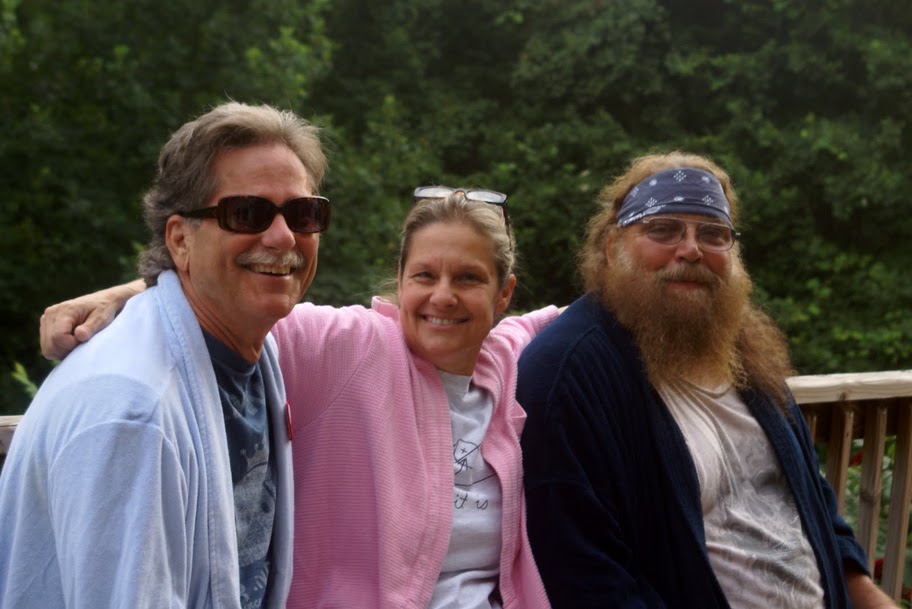
Michael, Rocky and me in Nova Scotia one bright summer day
    I had a friend back then, who also lived on the lake. Janet would ask “what is Rocky up to? He’s such a funny little guy.” And I would entertain her with stories of Rocky’s latest antics. We were in a contest to see whose little brother could do the craziest thing.
   Janet’s own little brother once jumped into the washing machine, while it was going, and broke his leg. While he recovered, Janet’s mother would have us come to their house after school to play with him, as much as that was possible—it was like trying to get a kitten to stay put—as he languished for weeks on the couch in a massive cast. Rocky’s casts, and he had plenty through the years, never rendered him immobile. Even a broken leg and cast did not keep him from riding his motor bike around the yard or from hiking into the woods, on his trusty crutches.
    Today’s parents keep a much better eye on their kids. Kids don’t play outdoors, unsupervised, for hours on end, and they learn to read before they learn to swim.  They are far worldlier than we were, and suffer way fewer broken bones. But they are still funny.
    One early summer evening, my baby grandson watched as his father tilled the garden patch.
John and Will catch a fish
    “Will,” his father said, “do you remember last summer when we had a garden here and we grew cucumbers and tomatoes?”
    Yes, he did, Will said.
    “And do you remember all the other good food we raised here in our garden?”   
    Again, Will remembered.
John and Will
    “Will, what would you like to grow in our garden this year?” his father asked.
    “Cake,” Will answered.
    The same kid, now 8, went to chess camp this summer. He came home, sat down with his father to a game, and beat him in three moves. Later that night, at the dinner table, Will’s little brother John, 5, announced that when he grows up he plans to be a fireman. His parents nodded their approval and then asked Will what he wanted to be when he grows up.
    “A professional football player,” Will said. “What would you want your son to be? A big star who brings home the bacon, or a guy who gets cats out of trees?”
John & Will with their amused parents
    John, 5 now, and, like his brother Will about as smart as a little kid can be, started a new school this week. On day two of his school career John ran into trouble for talking at a time when he was supposed to be being quiet, and for not taking a rest at nap time. When his mother asked him about his misdeeds, John reasoned them away. As for talking on line—he was “only telling a couple of knock-knock jokes.” And at naptime, “the teacher wouldn’t even let me get a book.”
    My friend Stephanie, who lives up the Keys, told me this about her little boy.
    “The mosquito truck is coming by,” Stephanie said.
    “Oh Mom,” he said, with a heavy sigh, “don’t we have enough mosquitos yet?”
    A little Key West kid, around 5, whose parents shall remain unnamed, had to have stitches. The doctor patiently explained each step of the procedure, and the kid did well. A week later, he was returned to the doctor’s office for the removal of the stitches. Just like before, the doctor patiently explained to the little guy what would happen next.
    “This is what I'm going to use this to remove those stitches,” the doctor said, holding up a shiny, silver hemostat.
    “A roach clip?” the kid gasped.


 A new funny kid story: Grandson John, 5, is a genius at remembering maps, states and capitals. You have to know that to understand why Michael and I were howling with laughter when this arrived from Michael's daughter Meredith. 

Meredith:  John, WHAT is that on the couch?

John:  I don't know.

Meredith: You are the only one in here. What is that on the couch?

John:  Idaho.

Thursday, September 1, 2011

Letting Go

Dr. Siddhartha Venkatappa, Oncologist
Yesterday Key West said goodbye to our two-day-a-week oncologist, Dr. Siddhartha Venkatappa (Dr. V), who will return, full-time, to his practice in Miami. Not to worry, people. The office will stay in its same location on the Boulevard, same wonderful staff, with a new oncologist taking over. We will not be without a cancer doc.
    After all these years, actually most of my life, in quirky, come-and-go Key West, it still makes me sad when a person or a place that has become a fixture in our community, leaves. I’m sure Dr. V’s wife and children are happy that he’ll be home more often. His partners in Miami will be pleased, too, to have another doctor to share patients every day of the week. But for those of us whose relationship with Dr. V is based on the most frightening and life-altering event life can offer, a deadly cancer, the connection is strangely intimate. And thus, important.       
    Dr. V has seen me taken down by chemotherapy to a pitiful, bald scarecrow. He has seen me choking on my own tears, and kindly waited for me to regain my composure. He has told me that he has no idea of how long my remission from cancer will hold. Of course no one does, but at least Dr. V has the honesty to say it to me, out loud, and to stand by that diagnosis a whole year down the road from my last cancer treatment. I appreciate knowing that truth, brutal though it sometimes feels.
    Through the two years we’ve known each other, we’ve made a few adjustments in how we communicate during in our brief encounters. For example, the first time I went to him as a patient, Dr. V referred several times to “the man upstairs,” and I had to remind him that I was there for medical treatment, not faith healing. There has been no more talk of the man upstairs.
Brother Rocky and me, August, 2010.   Rocky told me that when he left Key West that day he believed he would never see me again. Two days later our Mom died.
    I have learned that Dr. V will carefully consider each and every question I put to him, and respond as if writing the answer to an essay question, listing information and building a case for his bottom line.  One day, after one of his patients, someone I knew,  died unexpectedly when their cancer took a sneaky and vicious turn, I asked Dr. V “Aren’t you frightened by this cruel disease of cancer?” and he replied “Absolutely not! If I was intimidated by cancer I certainly wouldn’t have chosen to become an oncologist.”    
    I have heard that many of Dr. V’s siblings back in India are lawyers and that he is the first doctor in the family. Dr. V has told me that his was an arranged marriage and that by the time he actually met his wife, they were engaged to be married. Of course the Internet has taken away much of the mystery of the arranged marriage, he said. But isn’t it nice to imagine starting out a relationship with a grown up person who, like you, is seeking marriage and a family? So neat and scientific. Like oncology. You almost envy it. It’s so hard here in America finding The One.
    Once I saw Dr. V in the airport. He was deep in conversation with another guy, but I politely requested his attention for a moment, to explain to him how baffled and frightened we were about what we’d heard was going on with a loved one. I know this is shamefully akin to asking a doctor at a cocktail party to examine a mole on your foot—but like I said, there is an intimacy between the cancer patient and the cancer doctor that, in my mind, cancels out self-consciousness. My son and I were headed to the hospital bed of his suddenly very sick father. Dr V left his seat to come to where my very distraught son was sitting and explained to Miguel and me what would probably happen. And he was right. What he told us turned out to be pretty much what happened to Miguel’s dad—who is fine today, just like Dr. V said he probably would be.
Miguel and me (in a wig), November 2010
    Yesterday I told Dr V of a dream I’d had many years ago, before I came to Key West. In it, I was told that I would have a long, happy life and then die of leukemia. Dr. V told me about Freud’s theory of dreams, which he happens to be reading currently. He says dreams are bits and pieces of events from the past few days or weeks, aligned by the imagination, and arranged into a story that makes sense to the dreamer. He suggested that dreams don't actually predict the future, or even mean that much.
      He added that if I did get leukemia due to changes in my bone marrow brought about by the chemotherapy and radiation treatments, it would happen ten to fifteen years from now. And if that happened, if I were to live that long, my treatment would be considered to be very, very successful indeed. And dying of leukemia, he added, is really not a terrible death.
    Last night I dreamed I was jogging on the beach and then couldn’t find my way home to my downtown neighborhood. As I wandered, I found myself at the (defunct) Dennis Pharmacy Luncheonette, talking to an old woman, dead and gone now, who worked there long ago. I asked her to direct me to my house on Truman Avenue, and she pointed, saying, “right over there.” But no road ever took me home. I woke up, thinking Freud was so wrong. Dreams so do mean something.

Thursday, August 25, 2011

High in the Smokies with Valerie Hoh

Dennis and Valerie, Bryson City, N.C. August 2011
Twice lately people have sent to me photographs of bears walking in their back yards—one photo accompanied by an invitation to visit Asheville. No thanks. Why don’t you come here? I said.  So a couple of weeks ago Valerie Hoh and her husband, Dennis, came to our vacation rental house in the Smoky Mountains. We’d rented a big house there for a reunion with our kids. By Monday the kids had all left. We’d rented the house for the entire week. So we invited Valerie and Dennis over—they live in Asheville—to share in the pleasure of the Smoky Mountain air and a refrigerator full of left-behind food. We’d over-shopped, of course, and everyone had arrived with treats. There were melons and
Valerie and June feeling special in Hip-Hop Wraps
peaches and tomatoes and peppers and onions and cheese, bacon and eggs. We needed help!
    For many years Valerie and Dennis lived in Key West. An artist with a head for business as well as design, Valerie operated the store Pandemonium, on Duval Street. It featured beautiful and artistic things to wear and use and live with. In the same building she opened a gallery of work by Cindy Wynn, another truly innovative artist. Wynn creates furniture out of discarded metal and steel objects. Valerie called the store/museum Reworx.  Perhaps it was ahead of its time. Reworx didn’t seem to catch on.
    In 2005 Valerie and Dennis decided that Key West had become too challenging financially, and that Asheville would be a more manageable place to live. They sold their Key West house at the height of the real estate boom, and moved to Asheville. Valerie says she hasn’t regretted the move for a single second. Of course they do spend two months in Key West each winter and that’s gotta take the sting out of spending the other 10 months in bear country. 
Flip-Flop Hip-Hopper Miguel Perez in Valerie Hoh
    Valerie is also interested in cooking, and together, in the mountains, we fashioned several divine meals. Valerie, described by our mutual friend Jon Hynes as “a sort of life coach”, is full of great information and advice on a wide variety of subjects, from food, to fabric, to finance. She is currently involved in a movement to prevent a condominium complex from being built in her neighborhood. Valerie says she is making a name for herself in Asheville as a political activist, yet another focus of her bright light. She maintains her sparkling vitality with Tai Chi as well as a daily exercises called Somatics. Dennis does a set of yoga poses and stretches each morning. They meditate daily.
     One afternoon, as we danced together, Valerie told me that in Asheville Dennis goes to a studio where he dances to the 5Rhythms, a sort of philosophy of dance and movement by Gabrielle Roth. I downloaded some 5Rhythm music onto my iPod and dance to it at the beach. When people see me gyrating to the rhythms in my head, they stare, and I tell them: "Valerie Hoh made me do it!"
Michael Keith, in Valerie Hoh, 1987. "You should be a work of art or wear one." Oscar Wilde. I married one.


Anne, in Valerie Hoh, at our wedding, 1988.
    One day Valerie wrapped a fabulous thing around my head, wearable art by Valerie Hoh. It’s called a hip-hop wrap and she says it makes you feel special to wear it. It does! I call it my “Hoh Do-Rag.” As in “Hoh does” ... and does and does! One night she wore her hip-hop wrap and I wore mine and we took photographs—for you! 
     Last night son Miguel, producer of a brand of music he calls “flip-flop hip-hop”, expertly wrapped the Valerie Do around his head as if he’d done it a thousand times before. Then he posed for my camera.
    In February, Valerie stages a show of her incredible fashions at Key West's Gardens Hotel. There is music, food and drink, and since Valerie does everything she does with drama, wit and flair, the show is a terrific event. Her devoted Key West fans show up to socialize and have a look at what new ideas Valerie has brought to life. The pieces are for sale, too. In the meantime, check out Valerie’s stuff at HohCouture.com.  Plug in iamfurniture.com to see Cindy Wynn's wild works. 
     Wondering who else has a bear in their back yard? Our great friends Eugenie and Tad Malek in Northampton, Mass.  Eugenie is a brilliant world class pianist, who I’ve had the great pleasure of knowing since my childhood.  But that’s another blog. In the meantime, I gotta say, those art-loving bears get around!

 Check out Flip-Flop Hip-Hop featuring our son Miguel here:

Tuesday, August 16, 2011

A Great Funeral

Our family, being Lebowskis
A few months ago, after the passing of a friend for whom there was no plan for funeral arrangements, my husband and I had the Big Talk about how we would want things to go should one of us shuffle off this mortal coil.  Between us we've endured several bouts of cancer, a heart attack and the assorted atrocities of growing older. We've seen good friends, super specimens of vitality, succumb to illnesses and death. We've been to funerals that seemed to have nothing much to do with the departed soul as we knew them. We know what we don't want to happen. So we decided we needed a plan.
     "I want a big party with lots of laughing, dancing, and fun for my send-off," I said.
     "I would like for my kids to be together, all in one place, to celebrate my life," Michael said.
The Dude (Michael), Susan (my co-conspiritor) and Walter (Rocky)
     Then, we thought: What are we waiting for? Let's do this thing now. Let's celebrate our lives with the people who mean the very most to us. Let's do it now, while we still have our dancing feet in gear. And so the Smoky Mountain family retreat was conceived.
     We decided on a rental house in Bryson City, North Carolina, a place special to Michael and me. When he was a child Michael's family vacationed in the Smoky Mountains. We'd gone there for our honeymoon. It was much easier for our kids to access Bryson City than Key West. Through VRBO (vacation rental by owner) we found a big house, on the side of a mountain, and after much investigation, found it to be the perfect setting for our party.
We love the Dude!!
     Michael's birthday is in August, and so the kids and I decided to stage a party for that, and for him. His favorite movie is The Big Lebowski. Oldest daughter Susan and I decided on a Big Lebowski-themed party, which set off weeks of hushed telephone planning sessions, and many visits to thrift shops for plaid shorts and baggy bathrobes with hanging belts. Youngest daughter Meredith created "In and Out Burger" wrappers for the hamburgers we would serve at the party. Miguel, our son, downloaded the entire musical score of the film on my iPod. On our way out the door I grabbed The Big Lebowski DVD and threw it into my suitcase. Everyone, from the Dude himself (Michael) to our 5-year-old grandson arrived packing a robe and plaid shorts. Everyone had been instructed to watch The Big Lebowski and be ready for speaking in nothing but quotes from the film.
The Dude abides
     A few days before leaving Key West for the mountains, Michael, the guy who would rather have a root canal than endure a surprise birthday party, said: "You're up to something."
   "What could we possibly be up to?" I said. "Do you imagine we would set up "Michael Keith—This is Your Life" in the heart of the Smoky Mountains?? Shut the F--- up, Donnie!" (It's a line from the movie.)
Costume for the Big Lebowski party
     By the weekend, we had assembled in that house on the mountain all four of our kids, my brother Rocky (our fifth kid), all four grandkids, and a plan for a Saturday night cook-out featuring In and Out Burgers, and music from The Big Lebowski. While Michael sat outside, innocently communing with nature, we all slipped into our Lebowski costumes. Then we hit the button on the iPod player and called Michael into the house and handed him a White Russian, the Dude's favorite drink. We got him. He was surprised. But since our guests were all family, he was not horrified, but rather, very amused. We had a ball eating, dancing, and trying to not say the F word, so integral to The Big Lebowski script, in front of the kids. Sometime in the middle of that night, while we Lebowski fans slept, some creature came onto the porch, knocked over a trash can, pawed through our greasy In and Out Burger wrappers, and apparently attempted to eat a football. The ball, which my son-in-law said was made of finest pigskin, was punctured and deflated. Wow!
Partying at our own funeral
     Now we're back home, remembering our nine days in the mountains. Many times we've gone over again and again the many events, days and nights, and funny moments we experienced on that special vacation. We've marveled at the miracle of somehow assembling each and every one of our kids and their kids together.  Michael says it was one of the best times he ever had with his kids.
     "It really was a great funeral, wasn't it?" he says.

Saturday, July 23, 2011

Is This The Way To The Hemingway House?

Key West's #1 Tourist Attraction: The Ernest Hemingway Home  
It’s Hemingway Days again in Key West and you just can’t avoid thinking about Hemingway and what his celebrity has brought to our island city. Whenever we go out on our front porch we are asked by tourists for directions to Key West's number one tourist attraction. In fact, it’s just around the corner, but the appearance of locals, who might know the way to Hemingway's, is apparently irresistible and one or another in every passing pair or party pauses to ask “is this the way to the Hemingway House?”  Maybe they expect the appearance of something more spectacular, something like a Vanderbilt Mansion looming majestically above the modest tin roofs of the neighborhood’s wooden houses. The Hemingway House is surrounded by a red brick wall, its gates locked tight every day at 5 p.m. unless someone rents the grounds for a party or a wedding or something like that. I always tell tourists to look for the red brick wall.  Just about anytime you walk past the Hemingway House there is a crowd of people there, waiting to get in, or posing for photos, or jumping up for a peek over the wall after 5 p.m.   
Ernest and Pauline around the time of their marriage
    The late Jeanne Porter, who grew up on Whitehead Street, played with Hemingway's sons when she was a little girl.  One day she told us this story: The boys kept several raccoons in cages outside in the yard. The animals were named after movie stars. One day it was discovered that a raccoon named Greta Garbo had killed and was eating her cage mate, Harold Lloyd. Although disturbing Papa Hemingway when he was in his writing studio was strictly taboo, the children’s horrified screams brought him to the scene. When he saw what was happening he went into the house and returned with a shotgun. Then, in full view of the children, he wordlessly shot off the head of Greta Garbo and returned to his studio. Jeanne said they thought perhaps Papa suspected that Greta Garbo had rabies. But the episode shook her badly, so badly that she remembered it quite clearly 60 years later.
"That writer with the bullfights." The Hemingways in Pamploma, 1928
    I was in the eighth grade when I read The Old Man and the Sea and wrote an essay that made me very proud indeed. It may have been the first time I realized that a story can be much more than just a story, that a whole can be way bigger than the sum of its parts. I wanted to be a writer and understanding Hemingway’s brevity was a wonderful lesson. Many years later, when my son read The Old Man and the Sea, as a junior in college majoring in English, he was so swept away by the tale he said he wanted to get a tattoo honoring Hemingway. I told him he should maybe know a little bit more about the writer before tattooing himself for life with the image of Hemingway.  
Ernest and Pauline, Key West, 1930's
    Hemingway came to Key West with his second wife, Pauline, in search of a quiet place to write, it is said. Pauline was from Piggott, Arkansas. The house in which she grew up is also preserved as a museum, and in touring it you learn that Pauline grew up with many advantages. Her family had money. And connections. That’s how Pauline got a job with Vogue Magazine in Paris, where Hemingway and his first wife, Hadley were living, supported by Hadley’s modest inheritance. In spite of her strict Catholic upbringing, Pauline found herself hopelessly in love with Hemingway and soon became the second Mrs. Hemingway. Financially she was far better off than Hadley.  Her uncle, founder of the Richard Hudnut cosmetic brand, bought his niece and her writer husband the house in Key West as a wedding present in 1931. It cost him $8,000. It was the first house Hemingway owned. He was 32 years old.
    He did not live for long in the Key West house. In 1936, at Sloppy Joe’s Bar, he met the woman who was to become his third wife, a renowned journalist with a thirst for adventure. He divorced Pauline and married Martha Gellhorn, who writes, in her memoirs, that the great Hemingway was not much of a lover. In fact, she wrote, she was certain that in spite of his macho reputation, the only women he’d ever bedded were the four women he married.
    “I want to write a blog about why I think Hemingway was a lousy lay,” I told an artist friend the other day.
    “Of course he was,” my friend said. “He hated women.”
    So that’s the general take on Hemingway’s machismo around here. 
Peeking over the wall
    In the television series The Sopranos, young Christopher Montelsanti wants to be a writer. As he struggles over his computer, bemoaning the agony of creating enough pages to add up to something publishable, wise guy Paulie Walnuts warns him about the frustration of writing: “That writer, with the bullfights!” he says. “ He blew his own f’ing head off.”
    People touring the Hemingway House often ask the guides to show them the room where Hemingway shot himself. It happened in Idaho, not Key West. Hemingway was 61 years old, and had just complained to a close friend that as a writer, he could not retire (in fact, a rather cheering thought for me). Writers have to write and produce, no matter their age, he said. And Hemingway could write no more. It made him crazy enough to kill himself. 
Spencer Tracy and Hemingway during the filming The Old Man And the Sea, Cuba 1957. Tracy was nominated for the best actor Oscar. He lost to David Niven's performance in Separate Tables.
    The Old Man and the Sea will show at the Tropic Theater tonight. Tickets are $50 as it is a fundraiser for the local suicide hot line. The film is about a Cuban fisherman down on his luck when he hooks a giant fish that pulls him way out to sea. Hemingway was at the top of his game when he wrote Old Man, his finest work, for which he was awarded the Nobel Prize for Literature. Hemingway’s story is much bigger, but every bit as sad as the old Cuban fisherman’s. Hemingway hooked a big fish, too, the big fish of fame, and that fish pulled him far out into the sea of insanity, from which he could not return.

Thursday, July 14, 2011

Coma, Part 2

My all-time favorite photo of Jen
Waking from a coma is a slow and dramatically difficult struggle. When a patient stays longer than four months in a coma, medical people start looking at the grim statistics; only 15% of them will come out again. They stop looking for the miracle of a recovery. For Jennifer, nearly five months passed before she began to signal her reawakening by frantically wiggling her left big toe.
(seated) Stacy and Jen with Sophie, top: June and Valerie

    We were alone in her hospital room the first time I saw Jennifer awake. It was a few days after her birthday. She was sleeping peacefully, and then, her eyes moved beneath their lids. “You’re dreaming,” I said. “You’re snoring a little bit, too.” And then her eyes opened and she looked directly at me.  I was so stunned I nearly fainted. I knew she’d been showing signs of consciousness, but I was not prepared for the shock of the moment when she opened her eyes and gazed into mine; they were brightly green, focused, curious. They were Jennifer’s eyes. Imagine how you might feel if a loved one had died and then, awakened from that sleep to look deeply into your eyes and your soul. What would you say? What would you do? Chills zipped up and down my arms and legs. I cried. And then she cried.
    “No, don’t cry because we’re alive and we all love you so! You’re getting better. You’re going to be all right,” I assured her in a mad jumble of works. Then I laughed, while I cried. I took her hand in mine and she squeezed it and smiled, a half smile on the left side of her mouth. It felt like she was showing off.
    “Hey, look at my hair!” She lifted her eyes to my head to examine the full mop of hair on my head. I’d been chemo bald and chemo beaten when her brain exploded, back in September. To her, I must have looked like a different person. But she seemed to recognize me. And surely, I recognized her.
Baby Sophie and Mama Jen
    Jennifer’s home now, with full-time nursing care. She’s busy with therapy and learning to do all the things people do to manage being alive. After a brain trauma the healthy brain cells learn to take over the work of the injured or destroyed brain cells. This is a miracle of nature, and no one knows how it works or how to make it work any faster or better than it does on its own. Does it matter that Jennifer is an extremely intelligent person? Maybe. Does it matter that she was in prime physical condition when it happened? Yes, surely her good health contributed to her survival.  How long will the healing take? Years, probably. But there is progress, and it’s quite remarkable. A month ago, for example, Jen could hold her neck erect, her head up, for seconds. Now she does this for minutes. She turns her head in any direction she wants. She uses sign language because she has a tracheotomy and cannot yet talk. However, she mouths words, and loves to sing along to her favorite music.
Jen with the Bunnies, Tessa and Sophie
    From my reading about recovery from brain trauma I know that every accomplishment, no matter how minute, is particularly exhausting for Jennifer. That includes receiving visitors. And so Jen pushes herself when she can, and rests often. Recovery continues, day by day.
    “Inch by inch, it’s all a cinch,” I tell her, repeating something she often told me. She smiles. She remembers.
    Yesterday I visited Jen and her wonderful nurse told me she wished she’d known Jennifer before her accident. She wanted to know more about Jen’s personality, what sort of a person she is. And so, with Jennifer nodding to confirm the finer points of my personality portrait, I told her nurse these things about Jen:
Somebody's birthday. Jen, June, Stacy, Whitney
Jen loved burgers at the (sadly defunct) Deli on Truman
    She doesn’t like strong perfume. She is allergic to eggs. She loves make-up, lipstick and clothes with just a bit of ruffle. She prefers her hair short and low maintenance. She eats like a bird. She is tall and regally trim and has always been so, built like her grandmother. She used to drink Coca-Cola, I always kept some in my house for her, but then she decided it was not good for her and quit. She is a minimalist and likes her home simple and serene. She is a poet and a writer. She is a graduate of the Tisch School of the Arts at NYU in New York. She grew up in New Jersey. She is a certified lifeguard. She loves to swim. She is Catholic; she prays; she goes to confession. She has two daughters, beautiful and bright and well-raised as Jen takes the job of motherhood very seriously. She is the kind of mother who gives a toddler a leaf of fragrant basil to keep her entertained while Jen cooks dinner. Six years ago she went to a monastery in Kentucky and prayed, in total silence, for a week. When an ambulance drives by she pulls off to the side of the street and says a prayer for the person being transported. She loves gardening. She loves cooking. She loves coffee. She loves apple pie. And she loves me. I know. Yesterday, she mouthed the words and told me so.


Need a little cry? Cry to the good stuff. This always works for me.

Thursday, July 7, 2011

Coma, Part 1

June and Jen. Before cancer. Before coma. Spring, 2006. 
“Something terrible has happened to Jenny,” Michael said, bounding up the stairs, the ancient steps creaking beneath him. We were in Nova Scotia, on a mission to scatter my mother’s ashes in the places she’d loved growing up there. We were recovering from Mother’s death after a long and difficult illness, and from my four-month long bout of chemotherapy—two dramas that weirdly zenithed at the same time. We were stunned and weary from the rough summer. The day was overcast. I was in bed, staring out the window, gathering together the strength to face another day.
    “Something terrible has happened to Jenny,” Michael said, plopping down on the bed beside me and opening his computer. My heart slowed in that horrible thudding way it does when you hear terrible news. My mind darted desperately about, imaging what might have happened to Jennifer. I’d received an email from her a day earlier. She’d written happily, and funnily, about applying to a graduate program in creative writing. Her health was sterling, from regular swims and walks with her dog, Stella. A car wreck? No. I remembered that her husband Joe had insisted on Jennifer driving an industrial strength SUV. I thought of Jenny’s daughters, Sophie and Tessa, “the bunnies” she calls them. But it was Jenny. He said Jenny. And then he read aloud from an email from Key West in which we learned that Jennifer had collapsed at her home as a result of what appeared to be a brain bleed. She’d been flown to Miami. She was in a coma.
    It’s a silly term, best friend. But Jen and I are each others' best friend. Her daughters call us “BFFs”, best friends forever, I think that means. Recently someone asked us, “how are you two related?” Jennifer thought for a minute and answered, “We’re related . . . but not by blood.” When Jennifer took me to my chemo and radiation treatments, people thought she was my daughter. And she could be, as she is nearly twenty years younger than I.  I love her as if she were my daughter. She calls me “Mama” and I often sign off my emails to her as “your fairy godmother.” She’d even promised to take care of me when I am old.
    “That old woman there?” she’d say, laughingly imaging a time in the future. “That used to be June Keith.”
    And we’d laugh, because we always laugh. We share a sense of the absurd, of the sweet insanity of life on this earth. Jennifer knows my weaknesses and my strengths; I like to think I know hers, too. True friendship, they say, is loving another in spite of what you know about them. It’s a true friendship. 
    One day I introduced Jennifer, a uniquely intelligent person, to Joe, a man I sensed to be of the same beautiful brilliance. They fell in love. They married. They moved to a house in new town. Things changed.
    “I’m glad you two are so happy,” I teased them, “but I’ve lost my best friend!”
    It is unclear just what happened to Jennifer’s brain on that day, just as the brain’s myriad functions are largely a mystery. She was preparing dinner when she announced that she was having the worst headache of her life. She collapsed. Fortunately Joe was at home—what if he hadn’t been there when she lost consciousness? But he was there. Against all odds, Jennifer made it to Ryder Trauma Center in Miami. She survived two surgeries that night. And then, a coma.
    A person in a coma appears to be dead, but for the gentle in and out of the breath. Nothing moves. It is a state of suspended animation, a profoundly disturbing thing to witness. As she lay there, her serene beauty utterly still, I thought of a thousand conversations we’d had, the many what-if’s we’d explored together. One thing we’d never considered was this. Never anything like this.
    As the months went by, and Jennifer’s coma continued, friends urged me to come to terms with the idea of her being gone.
    “But she moves her eyes,” I said.
    “Only reflex,” people said.
    “She yawns,” I said.
    “Reflex,” I was told.
    Joe never gave up, and being a physician, a psychiatrist, he knew as well or better than any of us the gravity of the situation.  But Joe believed in Jennifer’s power to recover. If she’d given up, he said, she would have died at the beginning. She wanted to live, he told us. She was fighting to live. It might take a very long time, he said, but she would heal. She would be back, he promised.
    For months I cried at the thought of her. People wanted to know how she was. I had nothing to tell them, but that we hoped she’d regain consciousness soon. Michael and I cried together, and he always said “she was such a great mother,” and I’d admonish him to rephrase that to “she IS such a great mother.”
    We ached for Jenny’s daughters, beautiful babies we’d known since the days of their births. The bunnies.
    “They must know something we don’t,” the bunnies’ father told me one day. “They are confident she’ll get better and come home.”
    I read everything I could about comas. Everything. I learned that when a coma lasts for longer than four months, it is most likely to be permanent. Doctors and nurses I know well gently urged me to face the fact that Jennifer was gone. And so, as Jennifer’s birthday approached, I began the process of grieving the loss of her.
    And then, she woke up.